Licence: Public Domain Mark
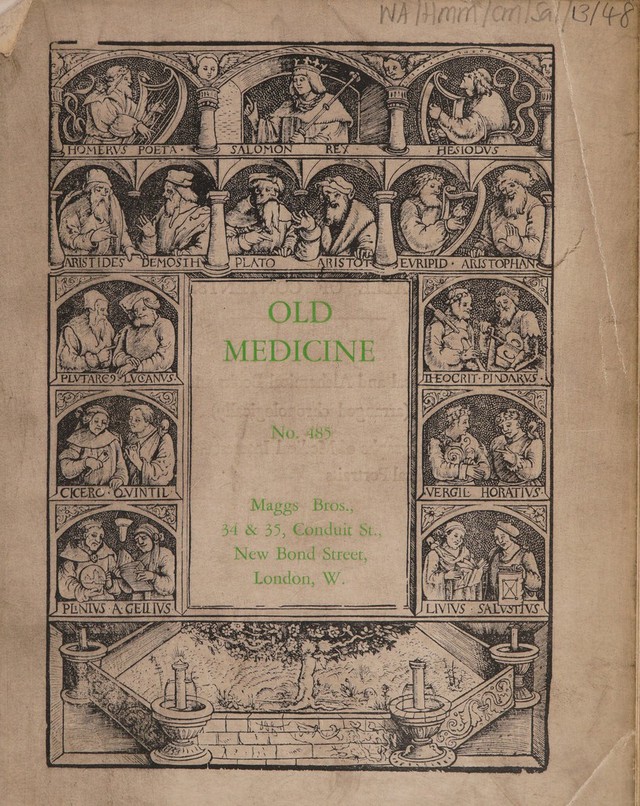
Credit: Sales catalogue 485: Maggs Bros. Source: Wellcome Collection.
9/322 page 3
![1475 A.D. ONE OF THE FIRST MEDICAL INCUNABULA. [4] DONDIS Jacobus de). Aggregator Paduanus de medicinis simplicibus. First Epirion. Brack Letter, double columns, 55 long lines to a full page. Folio. Original binding of wooden boards covered with pigskin. (Strassburg, the R-Printer, Adolph Rusch, about 1475.) £275 Hain Copinger *6395. Proctor 248 Pellechet 44385. British Museum Catalogue, Vol. I., p. 64. Osler, Incunabula Medica, 187. First edition of this very rare book, which is one of the first Medical Incunables known. Only one copy in the Public Libraries of France, that of the Bibliothéque Nationale. The Aggregator of Jacobus de Dondis, completed in 1355, is the first medical dic- tionary deserving of the name, and is, moreover, one of the rarest of early incunabula. It is a magnificent foho, printed with the much-discussed ‘‘ R-type ’’ on fine paper, and con- taining a large number of remedies for each symptom that has ever since appeared. ‘“ The work ig divided into ten tractates. I. De primis virtutibus medicinarum— long lists of medicine classified according to their primary qualities, hot or cold, dry or moist, and their combinations. II. De virtutibus medicinarum secundis—a classification of drugs according to their actions as resolvents, abstergents, laxatives, aperients, disgrega- tives (!), etc. JIT. De virtutibus tertiis medicinarum ad particulares egritundines a capite usque ad pedes—the largest section, dealing in order with all diseases from head to foot— the first occasion on which appeared in print this favourite mediaeval designation of a com- plete treatise. There is a large section on the eyes, and another on the teeth and gums, extending to ten pages. IV. Deals with general disdorders and superfluities of humours. V. Chiefly with fevers. VI. De pertinentibus ad partem decorationis, where ‘ decoratio ’ includes the care of the skin, toilet recipes, and cosmetics, besides love-philtres, ‘ vitam prolongatia ’ and the like. VII. Surgery. VIII. Poisons. IX. Veterinary medicine—de pertinentibus ad inhumana; and X. Names of medicines, simple and compound, grouped under their classes, or trocisci, colliria, clisteria.’’—(Osler, Incunabula Medica).](https://iiif.wellcomecollection.org/image/b31648903_0009.jp2/full/800%2C/0/default.jpg)


 No text description is available for this image
 No text description is available for this image
 No text description is available for this image