The mechanism of creative evolution / by C.C. Hurst.
- Charles Chamberlain Hurst
- Date:
- 1932
Licence: Attribution-NonCommercial-NoDerivatives 4.0 International (CC BY-NC-ND 4.0)
Credit: The mechanism of creative evolution / by C.C. Hurst. Source: Wellcome Collection.
366/400 page 338
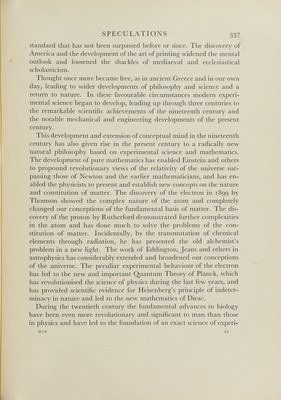
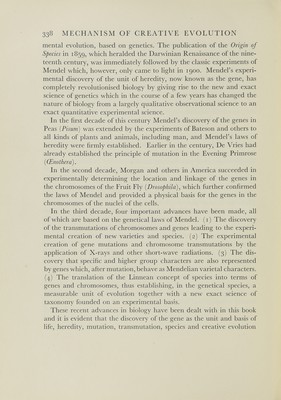
![338 MECHANISM OF CREATIVE EVOLUTION mental evolution, based on genetics. The publication of the Origin of Species in 1859, which heralded the Darwinian Renaissance of the nine¬ teenth century, was immediately followed by the classic experiments of Mendel which, however, only came to light in 1900. Mendel's experi¬ mental discovery of the unit of heredity, now known as the gene, has completely revolutionised biology by giving rise to the new and exact science of genetics which in the course of a few years has changed the nature of biology from a largely qualitative observational science to an exact quantitative experimental science. In the first decade of this century Mendel's discovery of the genes in Peas {Pisum) was extended by the experiments of Bateson and others to all kinds of plants and animals, including man, and Mendel's laws of heredity were firmly established. Earlier in the century, De Vries had already established the principle of mutation in the Evening Primrose [Œnothera]. In the second decade, Morgan and others in America succeeded in experimentally determining the location and linkage of the genes in the chromosomes of the Fruit Fly {Drosophila), which further confirmed the laws of Mendel and provided a physical basis for the genes in the chromosomes of the nuclei of the cells. In the third decade, four important advances have been made, all of which are based on the genetical laws of Mendel. ( i ) The discovery of the transmutations of chromosomes and genes leading to the experi¬ mental creation of new varieties and species. (2) The experimental creation of gene mutations and chromosome transmutations by the application of X-rays and other short-wave radiations. (3) The dis¬ covery that specific and higher group characters are also represented by genes which, after mutation, behave as Mendelian varietal characters. (4) The translation of the Linnean concept of species into terms of genes and chromosomes, thus establishing, in the genetical species, a measurable unit of evolution together with a new exact science of taxonomy founded on an experimental basis. These recent advances in biology have been dealt with in this book and it is evident that the discovery of the gene as the unit and basis of life, heredity, mutation, transmutation, species and creative evolution](https://iiif.wellcomecollection.org/image/b18022753_0367.JP2/full/800%2C/0/default.jpg)