The mechanism of creative evolution / by C.C. Hurst.
- Charles Chamberlain Hurst
- Date:
- 1932
Licence: Attribution-NonCommercial-NoDerivatives 4.0 International (CC BY-NC-ND 4.0)
Credit: The mechanism of creative evolution / by C.C. Hurst. Source: Wellcome Collection.
86/400 page 58
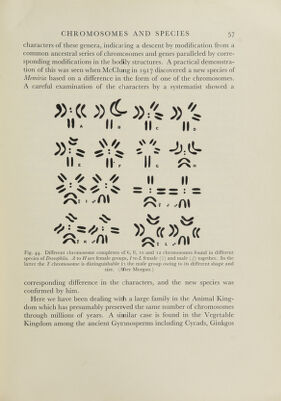
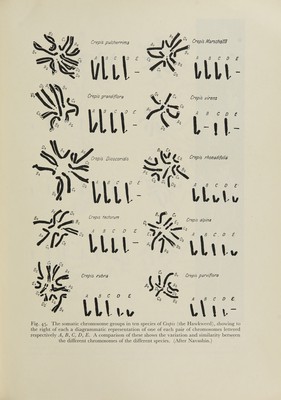
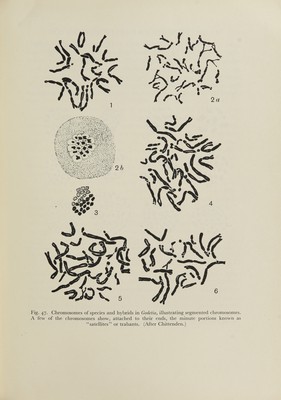
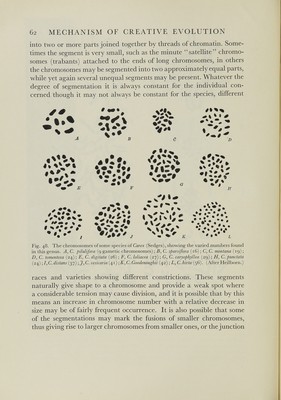
![58 MECHANISM OF CREATIVE EVOLUTION and Conifers. These, so far as examined, have, with few exceptions, each 12 pairs of chromosomes, a condition which must have persisted for many milHons of years. In other famihes the chromosome sets or genomes vary in the number and size of the chromosomes from species to species. This is the case in species of Drosophila, as will be seen in fig. 44. A study of this figure shows that most of these species may have arisen from a common an¬ cestor by the addition or subtraction of a pair of chromosomes, by fusion of chromosomes or by the breaking off of parts of chromosomes (frag¬ mentation) . Many experiments are being carried out with these species by various workers to test the relationships between them, but it must of necessity take many years to get a full and detailed account of the position of the genes in each, and then to work out the similarity of their corresponding genes and their relative positions in the different species. In an analysis of thirty species of these flies Metz has reduced the different chromosome sets to twelve principal types differing from one another in number, size and form (fig. 44), and it is evident that the degree of relationship between these species is equally manifest in the chromosomes as in the characters, indicating descent from a common ancestral species by modifications of the chromosomes and the genes they contain. Similar specific differences in chromosome sets are found in plants. In the Hawksbeard [Crépis], for instance, Navashin made a comparative study of the chromosomes of species with three, four and five pairs of chromosomes. Fig. 45 shows how these may be sorted out according to the shape and size of the chromosomes. The chromosomes of ten of the species may be sorted out into five different shapes to which are assigned the letters A, B, C, D and E. It has been found that the A, С and D chromosomes occur in all ten species, the В chromosome is in all but one species, while the E chromosome is found in three species only. The same shaped chromosomes, however, vary much in length and presumably carry variable numbers and arrangements of genes. Most genera, in addition to having chromosomes of different numbers and sizes, show other curious specific differences, some of the chromo¬ somes, or perhaps all, being segmented, usually at the point of attach¬ ment of the spindle fibres; that is to say, they are divided transversely](https://iiif.wellcomecollection.org/image/b18022753_0087.JP2/full/800%2C/0/default.jpg)