The diseases of the male organs of generation / by W. H. A. Jacobson ... With eighty-eight illustrations.
- W. H. A. Jacobson
- Date:
- 1893
Licence: Public Domain Mark
Credit: The diseases of the male organs of generation / by W. H. A. Jacobson ... With eighty-eight illustrations. Source: Wellcome Collection.
Provider: This material has been provided by the Augustus C. Long Health Sciences Library at Columbia University and Columbia University Libraries/Information Services, through the Medical Heritage Library. The original may be consulted at the the Augustus C. Long Health Sciences Library at Columbia University and Columbia University.
34/790 (page 14)
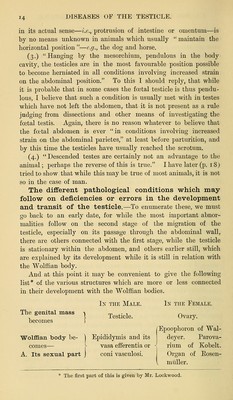
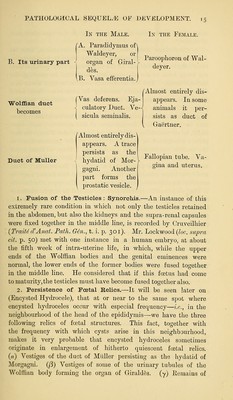
![in its actual sense—i.e., protrusion of intestine or omentum—is by no means unknown in animals which usually maintain the horizontal position —e.g., the dog and horse. (3.) Hanging by the mesorchium, pendulous in the body cavity, the testicles are in the most favourable position possible to become herniated in all conditions involving increased strain on the abdominal position. To this I should reply, that while it is probable that in some cases the foetal testicle is thus pendu- lous, I believe that such a condition is usually met with in testes which have not left the abdomen, that it is not present as a rule judging from dissections and other means of investigating the foetal testis. Again, there is no reason whatever to believe that the foetal abdomen is ever in conditions involving increased strain on the abdominal parietes, at least before parturition, and by this time the testicles have usually reached the scrotum. (4.) Descended testes are certainly not an advantage to the animal; perhaps the reverse of this is true. I have later (p. 18) tried to show that while this may be true of most animals, it is not so in the case of man. The diJBEerent pathological conditions -which may foUo-w on deficiencies or errors in the development and transit of the testicle,—To enumerate these, we must go back to an early date, for while the most important abnor- malities follow on the second stage of the migration of the testicle, especially on its passage through the abdominal wall, there are others connected with the first stage, while the testicle is stationary within the abdomen, and others earlier still, which are explained by its development while it is still in relation with the Wolffian body. And at this point it may be convenient to give the following list* of the various structures which are more or less connected in their development with the Wolffian bodies. In the Male. In the Female. The genital mass . ^^^^.^^^^ becomes I Epoophoron of Wal- deyer. Parova- rium of Kobelt. Organ of Eosen- m tiller. * The first part of this is given by Mr. Lockwood. Wolflaan body be- ] Epididymis and its comes— y vasa efferentia or A. Its sexual part j coni vasculosi.](https://iiif.wellcomecollection.org/image/b21217580_0034.jp2/full/800%2C/0/default.jpg)