The water supply of Kent : with records of sinkings and borings / by William Whitaker ... with contributions by H. Franklin Parsons ... Hugh Robert Mill ... and J.C. Thresh ... Pub. by order of the lords commissioners of His Majesty's Treasury.
- Whitaker, William, 1836-1925.
- Date:
- 1908
Licence: In copyright
Credit: The water supply of Kent : with records of sinkings and borings / by William Whitaker ... with contributions by H. Franklin Parsons ... Hugh Robert Mill ... and J.C. Thresh ... Pub. by order of the lords commissioners of His Majesty's Treasury. Source: Wellcome Collection.
105/414 page 95
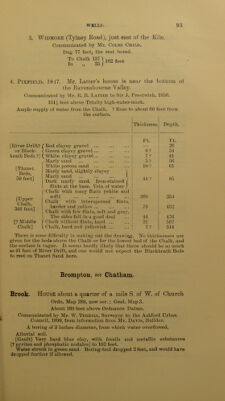
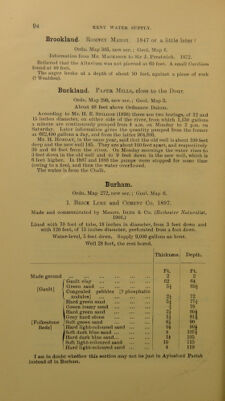
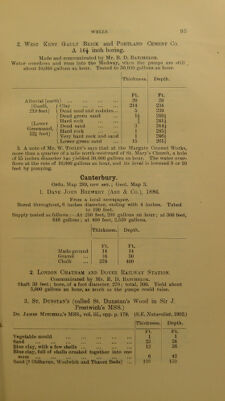
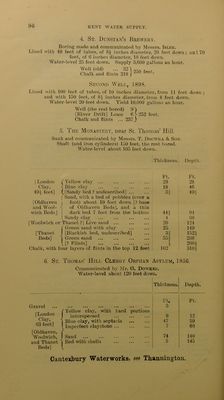
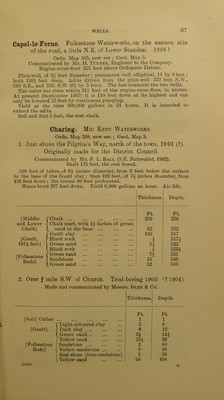
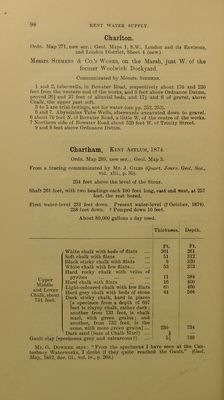
![2. West Kent G-ault Brick and Portland Cement Co. A 16* inch boring. Made and communicated by Mr. R. 13. Batchelor. Water overflows and runs into the Medway, when the pumps are still about 10,000 gallons an hour. Tested to 30,000 gallons an hour. Thickness. Depth. Alluvial [earth] f Gault, 210 feet] [Lower Greensand, 22* feet] f Clay \ Dead sand and nodules f Dead green sand j Hard rock j Dead sand \ Hard rock I Very hard rock and sand [ Lower green sand Ft. 20 214 5 n _3 4 3 1 1 15 Ft. 20 234 239 2405 241* 244* 245* 246* 261* 3. A note of Mr. W. Topley’s says that at the Margate Cement Works, more than a quarter of a mile north-westward of St. Mary’s Church, a hole of 15 inches diameter has yielded 30,000 gallons an hour. The water over- flows at the rate of 10,000 gallons an hour, and its level is lowered 8 or 10 feet by pumping. Canterbury. Ordn. Map 289, new ser.; Geol. Map 3. 1. Dane John Brewery (Ash & Co.), 1886. From a local newspaper. Bored throughout, 6 inches diameter, ending with 4 inches. Tubed to 190 feet. Supply tested as follows :—At 250 feet, 288 gallons an hour ; at 300 feet, 648 gallons ; at 400 feet, 2,520 gallons. Thickness. Depth. ■ Ft. Ft. Made ground 14 14 Gravel 16 30 Chalk 370 400 2. London Chatham and Dover Railway Station. Communicated by Mr. R. D. Batchelor. Shaft 30 feet; bore, of a foot diameter, 270; total, 300. Yield about 5,000 gallons an hour, as much as the pumps could raise. 3. St. Dunstan’s (called St. Dunstan’s Wood in Sir J. Prestwich’s MSS.) Dr. James Mitchell’s MSS., vol. iii., opp. p. 179. (S.E. Naturalist, 1902.) Thickness. Depth. Vegetable mould Ft. 1 Ft. 1 Sand ••• ••• ••• ••• ••• ••• ••• 23 24 Blue clay, with a few shells 12 36 Blue clay, full of shells crushed together into one m ass • • • ••• ••• • • # im ••• ••• 6 42 Sand [? Oldhaven, Woolwich and Thanet Beds] ... 10S 150](https://iiif.wellcomecollection.org/image/b28126737_0105.jp2/full/800%2C/0/default.jpg)