An improved system of domestic medicine : founded upon correct physiological principles : comprising a complete treatise on anatomy and physiology, the practice of medicine, with a copious materia medica, and an extensive treatise on midwifery, embellished with over one hundred useful engravings, gotten up expressly for family use / by Horton Howard.
- Howard, Horton, 1770-1833
- Date:
- 1856, ©1848-1852
Licence: Public Domain Mark
Credit: An improved system of domestic medicine : founded upon correct physiological principles : comprising a complete treatise on anatomy and physiology, the practice of medicine, with a copious materia medica, and an extensive treatise on midwifery, embellished with over one hundred useful engravings, gotten up expressly for family use / by Horton Howard. Source: Wellcome Collection.
Provider: This material has been provided by the National Library of Medicine (U.S.), through the Medical Heritage Library. The original may be consulted at the National Library of Medicine (U.S.)
88/990
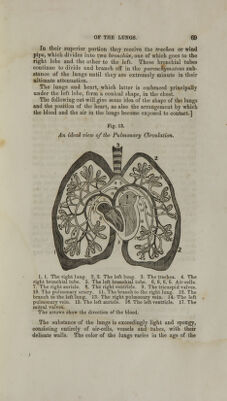
![OF THE RESPIRATORY ORGANS. [The materials furnished to the circulation from the alimen- tary canal are in a condition, that, with reference to the atmosphere, will admit of free combination with oxygen, which latter agent is quite necessary to the function of assimilation and nutrition, to prepare the tissues for this process. Besides this, the venous blood is also charged with carbon- ated materials that become eliminated and pass off in the form of carbonic acid gas when exposed to oxygen. To effect these several purposes and thus to keep up the motive power of the system, while also its recremental materials are removed, the apparatus of respiration is provided. The lungs are so constructed as to receive a very large amount of atmosphere, and by the most extraordinary mechan- ism of the cellular structures, the blood and air come into a state equivalent to direct contact with each other. Thus the oxygen of the air combines with the blood, while a portion of the carbonated and recremental materials also take on new combinations and pass off. In describing the lungs, it may be well in the first place to compare them to a bellows, which takes in air freely and then forcibly projects it forth again, only that in the case of the lungs the air is materially changed when it passes out, having yielded its oxygen, that was before in a free state, and holding the oxygen now passing out in a purely chemical state.] SECTION 1. OP THE LUNGS. [The lungs are situated in the uppermost portion of the chest, and when inflated fill that cavity completely. They are of irregular shape, having two main divisions, one right, and the other left, and each inclosed in a sack formed by the pleura membrane and the mediastinum. The right lung is the largest and is divided by two fissures into three lobes, while the left is divided by one fissure into two lobes.](https://iiif.wellcomecollection.org/image/b21130760_0088.jp2/full/800%2C/0/default.jpg)