Report of the Barrack and Hospital Improvement Commission on the sanitary condition and improvement of the Mediterranean stations / [Douglas Galton, John Sutherland].
- Great Britain. Barrack and Hospital Improvement Commission.
- Date:
- 1863
Licence: Public Domain Mark
Credit: Report of the Barrack and Hospital Improvement Commission on the sanitary condition and improvement of the Mediterranean stations / [Douglas Galton, John Sutherland]. Source: Wellcome Collection.
Provider: This material has been provided by London School of Hygiene & Tropical Medicine Library & Archives Service. The original may be consulted at London School of Hygiene & Tropical Medicine Library & Archives Service.
57/416 page 37
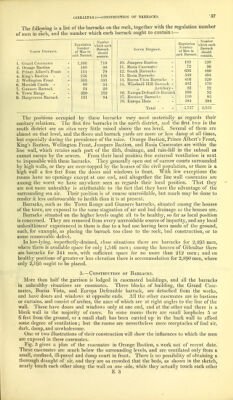
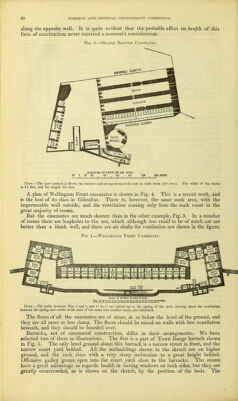
![GIBRALTAR :—CONSTRUCTION OF BARRACKS. The following is a list of the barracks on the rock, together with the regulation number of men in each, and the number which each barrack ought to contain :— North District. 1. Grand Casemates 2. Orange Bastion 3. Prince Albert's Front 4. King's Bastion 5. Wellington Front 6. Moorish Castle - 7. Gunners Barrack 8. Town Range 9. Hargreaves Barrack ]N umber of Men in each Barrack. Number which each Barrack should contain. 1,166 710 160 80 114 79 256 128 533 393 80 54 24 20 320 192 131 94 South District. 10. Jumpers Bastion 11. Rosia Casemates 12. South Barracks 13. Rosia Barracks 14. Buena Vista Barracks 15. Windmill Hill Barrack - Artillery - 16. Europa Defensible Barrack 17. Brewery Barracks 18. Europa Huts Total Regulation N umber r\i TVF**n in KJL J.TAG1J. Ill each Barrack. Number which each Barrack should contain. 192 120 72 36 696 480 549 494 416 320 402 170 22 22 100 92 110 85 384 384 5.727 3,953 The positions occupied by these barracks vary most materially as regards their sanitary relations. The first five barracks in the north district, and the first two in the south district are on sites very little raised above the sea level. Several of them are almost on that level, and the floors and barrack yards are more or less damp at all times, but especially during the prevalence of the rains. Orange Bastion, Prince Albert's Front, King's Bastion, Wellington Front, Jumpers Bastion, and Rosia Casemates are within the line wall, which retains such part of the filth, drainage, and rain-fall in the subsoil as cannot escape by the sewers. From their local position free external ventilation is next to impossible with these barracks. They generally open out of narrow courts surrounded by high walls, or they are over-topped by the houses of the civil population, or there is a high wall a few feet from the doors and windows in front. With few exceptions the rooms have no openings except at one end, and altogether the line wall casemates are among the worst we have anywhere seen as regards their local position. That they are not more unhealthy is attributable to the fact that they have the advantage of the surrounding sea air. Their position is of course unavoidable, but much may be done to render it less unfavourable to health than it is at present. Barracks, such as the Town Range aud Gunners barracks, situated among the houses of the town, are exposed to the same stagnation of air and bad drainage as the houses are. Barracks situated on the higher levels ought all to be healthy, so far as local position is concerned. They are removed from every unavoidable source of impurity, and any local unhealthiness* experienced in them is due to a bad use having been made of the ground, such, for example, as placing the barrack too close to the rock, bad construction, or to some removeable defect. In low-lying, imperfectly-drained, close situations there are barracks for 2,493 men, where there is available space for only 1,546 men; among the houses of Gibraltar there are barracks for 344 men, with sufficient space for no more than 212 men ; and on healthy positions of greater or less elevation there is accommodation for 2,890 men, where only 2,195 ought to be placed. 3.—Construction of Barracks. More than half the garrison is lodged in casemated buildings, and all the barracks in unhealthy situations are casemates. Three blocks of building, the Grand Case- mates, Buena Vista, and Europa Defensible barrack, are detached from the works, and have doors and windows at opposite ends. All the other casemates are in bastions or curtains, and consist of arches, the axes of which are at right angles to the line of the wall. These have doors and windows only at one end, and at the other end there is a blank wall in the majority of cases. In some rooms there are small loopholes 5 or 6 feet from the ground, or a small shaft has been carried up in the back wall to afford some degree of ventilation ; but the rooms are nevertheless mere receptacles of foul air, dark, damp, and unwholesome. One or two illustrations of their construction will show the influences to which the men are exposed in these casemates. Fig. 3 gives a plan of the casemates in Orange Bastion, a work not of recent date. These casemates are much below the surrounding levels, and are ventilated only from a small, confined, ill-paved and damp court in front. There is no possibility of obtaining a thorough draught of air, and they are so crowded that the beds, as shown in the sketch, nearly touch each other along the wall on one side, while they actually touch each other E 3](https://iiif.wellcomecollection.org/image/b21364916_0057.jp2/full/800%2C/0/default.jpg)