The synthesis of substances allied to epinephrine / by George Barger and H.A.D. Jowett.
- George Barger
- Date:
- [1905]
Licence: Attribution 4.0 International (CC BY 4.0)
Credit: The synthesis of substances allied to epinephrine / by George Barger and H.A.D. Jowett. Source: Wellcome Collection.
Provider: This material has been provided by The Royal College of Surgeons of England. The original may be consulted at The Royal College of Surgeons of England.
7/12 page 971
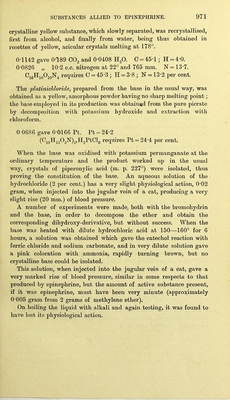
![crystalline yellow substance, which slowly separated, was recrystallised, first from alcohol, and finally from water, being thus obtained in rosettes of yellow, acicular crystals melting at 178°. 0-1142 gave 0-189 C02 and 0-0408 H20. C = 45T; H = 4-0. 0-0826 „ 10-2 c.c. nitrogen at 22° and 765 mm. N = 13-7. C16HlfiO10N4 requires C = 45*3 ; H = 3-8 ; N = 13-2 per cent. The platinichloride, prepared from the base in the usual way, was obtained as a yellow, amorphous powder having no sharp melting point; the base employed in its production was obtained from the pure picrate by decomposition with potassium hydroxide and extraction with chloroform. 0 0686 gave 0-0166 Pt. Pt = 242 (C10H13O3N)2,H2PtC]6 requires Pt = 24-4 per cent. When the base was oxidised with potassium permanganate at the ordinary temperature and the product worked up in the usual way, crystals of piperonylic acid (m. p. 227°) were isolated, thus proving the constitution of the base. An aqueous solution of the hydrochloride (2 per cent.) has a very slight physiological action, 0'02 gram, when injected into the jugular vein of a cat, producing a very slight rise (20 mm.) of blood pressure. A number of experiments were made, both with the bromohydrin and the base, in order to decompose the ether and obtain the corresponding dihydroxy-derivative, but without success. When the base was heated with dilute hydrochloric acid at 150—160° for 6 hours, a solution was obtained which gave the catechol reaction with ferric chloride and sodium carbonate, and in very dilute solution gave a pink coloration with ammonia, rapidly turning brown, but no crystalline base could be isolated. This solution, when injected into the jugular vein of a cat, gave a very marked rise of blood pressure, similar in some respects to that produced by epinephrine, but the amount of active substance present, if it was epinephrine, must have been very minute (approximately 0-005 gram from 2 grams of methylene ether). On boiling the liquid with alkali and again testing, it was found to have lost its physiological action.](https://iiif.wellcomecollection.org/image/b22401751_0009.jp2/full/800%2C/0/default.jpg)