Catalogue of the collections in the Museum of the Pharmaceutical Society of Great Britain / compiled by E.M. Holmes.
- Holmes E. M. (Edward Morell), 1843-1930.
- Date:
- 1878
Licence: Public Domain Mark
Credit: Catalogue of the collections in the Museum of the Pharmaceutical Society of Great Britain / compiled by E.M. Holmes. Source: Wellcome Collection.
Provider: This material has been provided by the Royal College of Physicians of Edinburgh. The original may be consulted at the Royal College of Physicians of Edinburgh.
72/322 (page 58)
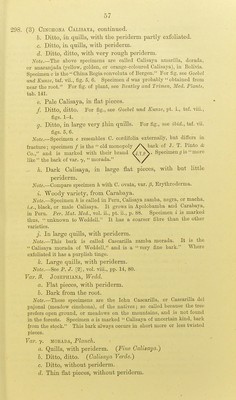
![298. (3) Cinchona Calisaya, continued. e. Thick and flat or slightly curved pieces. Note.—Yfxx. y, Morada, is the C. Boliviana of Wedd., the CascarUla morada of Bolivia, and the CascariUa verde morada of Peru. Specimen d IS known by the name of CharquesiUo (charque meanmg strips of sun- dried flesh). Specimen e is caUed tabla. It is a very fine bark. It differs from the CaHsaya morada of Weddell. See specimen d of var. a, Vera. According to Weddell CaHsaya bark may be distinguished from C. scrobiculata, H. and B., and from C. ovata, var. rufinervis, by the fibres being easily detached from a transverse fracture instead of being flexible and adherent as in the two latter barks. Per. Mat. Med., vol. ii pt. u., p. 88. In C. scrobiculata the fibres form radial and less interrupted rows. In C. Calisaya, var. y morada (C. Boliviana, Wedd.) the flat pieces possess laticiferous vessels, while the flat Calisaya does not; they are present, however, in the quiUs of both species, and the morada variety can then only be distinguished by its relative thinness. Pharmacographia, p. 320; P. J. [2], vol. viii., p. 14. (4) Cinchona cordifolia, Wedd. (Hard Garthagena Bark.) a. Large quills. b. Flat pieces. Note.—This bark is the hard Carthagena bark of Pereira, or hard Columbian bark of commerce, and the China flava dura of Bergen. lu Peru and Bolivia it is known as Cascarilla mula; and in Bogota as Quina amarilla. The quills are usually large, heavy, and without periderm ; sometimes of a tea green tint, and wrinkled longitudinally, but generally much resembling in colour those of C. lancifoha, from which they differ in having a very short, not fibrous, fracture. The fiat pieces are thin, hard, somewhat curved, and of a tea green or maroon tint, with the remains of a white periderm, and smaU fiat pale brown warts. The taste is earthy and bitter. Maracaibo bark (C. Tucujensis) was formerly included by Pereira and Planchon under this species. Hist, des Drag., vol. iii., p. 177. This bark is well figured in Del. et Bouch. Qiiinolog., pi. X. Carabaya bark somewhat resembles the flat variety of C. cordi- foUa, but it has a darker exterior, and the fibres are much finer, and the warts, are smaller and darker in colour. (5) Cinchona elliptica, Wedd. (Carabaya Bark.) a. Flat pieces. b. Quills. Note.—This bark is now scarcely imported. It formerly came from Islay, where it was known as Quina carmin. It much resembles the bark of C. cordifoha in aspect, but its taste is more astringent. It contains 3-4 per cent, of alkaloids, consisting of cinchonine, quinidine, and quinine. Per. Mat. Med., vol. ii., pt. ii., p. 95. For fig. of bark see Del. et Bouch., Quinolog. pi. ii. (6) Cinchona heterophtlla, Pav. a. Quills. Note.—This bark comes over occasionally mixed with quill Calisaya, and is known as CascariUa negrilla. It is much darker in coloiu and less cracked than any other quilled bark. See Hist, des Drog., vol. iii., p. 181. It contains the quinidine of Pasteur.](https://iiif.wellcomecollection.org/image/b21697358_0072.jp2/full/800%2C/0/default.jpg)