[Report 1962] / Medical Officer of Health, West Sussex County Council.
- Peter F. Neumeyer
- Date:
- 1962
Licence: Attribution 4.0 International (CC BY 4.0)
Credit: [Report 1962] / Medical Officer of Health, West Sussex County Council. Source: Wellcome Collection.
33/186 page 33
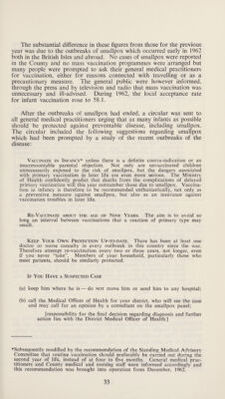
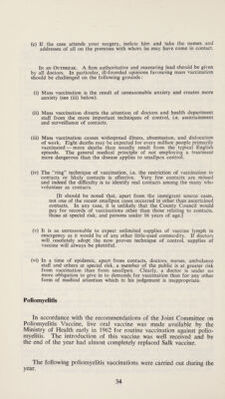
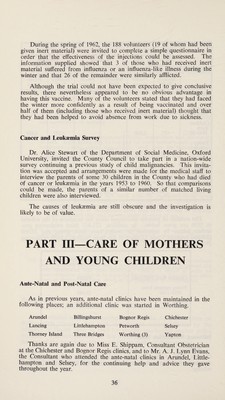
![The substantial difference in these figures from those for the previous year was due to the outbreaks of smallpox which occurred early in 1962 both in the British Isles and abroad. No cases of smallpox were reported in the County and no mass vaccination programmes were arranged but many people were prompted to ask their general medical practitioners for vaccination, either for reasons connected with travelling or as a precautionary measure. The general public were however informed, through the press and by television and radio that mass vaccination was unnecessary and ill-advised. During 1962, the local acceptance rate for infant vaccination rose to 58.1. After the outbreaks of smallpox had ended, a circular was sent to all general medical practitioners urging that as many infants as possible should be protected against preventable disease, including smallpox. The circular included the following suggestions regarding smallpox which had been prompted by a study of the recent outbreaks of the disease: Vaccinate in Infancy* unless there is a definite contra-indication or an insurmountable parental objection. Not only are unvaccinated children unnecessarily exposed to the risk of smallpox, but the dangers associated with primary vaccination in later life are even more serious. The Ministry of Health confidently predict that deaths from the complications of delayed primary vaccination will this year outnumber those due to smallpox. Vaccina¬ tion in infancy is therefore to be recommended enthusiastically, not only as a preventive measure against smallpox, but also as an insurance against vaccination troubles in later life. Re-Vaccinate about the age of Nine Years. The aim is to avoid so long an interval between vaccinations that a reaction of primary type may result. Keep Your Own Protection Up-to-date. There has been at least one doctor or nurse casualty in every outbreak in this country since the war. Therefore attempt re-vaccination every two or three years, not longer, even if you never “take”. Members of your household, particularly those who meet patients, should be similarly protected. If You Have a Suspected Case (a) keep him where he is — do not move him or send him to any hospital; (b) call the Medical Officer of Health for your district, who will see the case and may call for an opinion by a consultant on the smallpox panel; [responsibility for the final decision regarding diagnosis and further action lies with the District Medical Officer of Health.] *Subseqiiently modified by the recommendation of the Standing Medical Advisory Committee that routine vaccination should preferably be carried out during the second year of life, instead of at four to five months. General medical prac¬ titioners and County medical and nursing staff were informed accordingly and this recommendation was brought into operation from December, 1962.](https://iiif.wellcomecollection.org/image/b30264716_0033.jp2/full/800%2C/0/default.jpg)

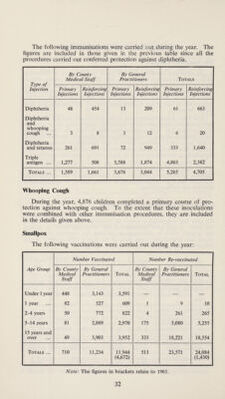
 No text description is available for this image
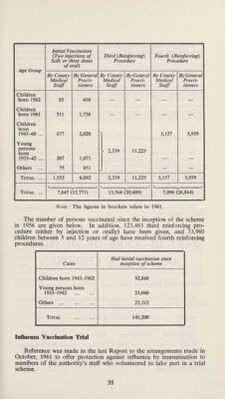
 No text description is available for this image
 No text description is available for this image