Essentials of practice of medicine : arranged in the form of questions and answers prepared especially for students of medicine / by Henry Morris ; with a very complete appendix, on the examination of urine, by Lawrence Wolff.
- Morris, Henry, 1856-1929.
- Date:
- 1897
Licence: Public Domain Mark
Credit: Essentials of practice of medicine : arranged in the form of questions and answers prepared especially for students of medicine / by Henry Morris ; with a very complete appendix, on the examination of urine, by Lawrence Wolff. Source: Wellcome Collection.
352/492 page 346
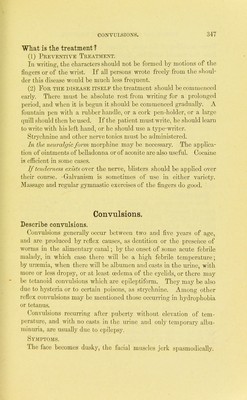
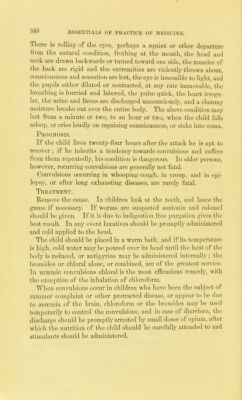
![without any spasm, which discontinues as soon as the patient ceases to write. The spasmodic form is the most frequent and characteris- tic. After writing for some time he finds that the pen does not move as he intended it should ; that every now and then the strokes are irregular; that he is grasping the pen too tightly, and that the index finger particularly has a tendency to slip from the pen. The hands feel tired and there is pain in the first finger or thumb, or wrist, or forearm. These symptoms continue for weeks, with a gradual impairment in the power of the muscle, gradually increasing in degree, with now and]then an acute spasm which cannot be controlled. As the spasm increases it extends and involves more and more of the muscles of the forearm until finally all these muscles may be affected to such a degree as to render the movements of the hand impossible. Occasionally the symptoms develop acutely and rapidly. The spasm is usually tonic. It is frequently limited to the act of writing. Electric reactions may be normal or slightly increased or diminished. Occa- sionally there is a tingling sensation in the fingers in attempting to write. Sometimes the pain is severe and neuralgic in character. The spasm, pain and tremor occasionally affects the other arm also. The sensory symptoms have a greater tendency to extend than the motor. Sometimes if the patient accustoms himself to write with the left hand, it also may be involved. Occasionally the foot of the same side is involved in the cramp and pain. What is the pathology of this disease ? No anatomical changes have been found. It is generally supposed to be due to a derangement of the action of the centres concerned in the act of writing. What is the diagnosis ? The diagnosis is based on the spasm, pain and tremor, particu- larly the former, accompanying attempts at writing. What is the prognosis? The prognosis is uncertain when the disease is well developed, particularly if the patient continues to write.](https://iiif.wellcomecollection.org/image/b28093562_0352.jp2/full/800%2C/0/default.jpg)