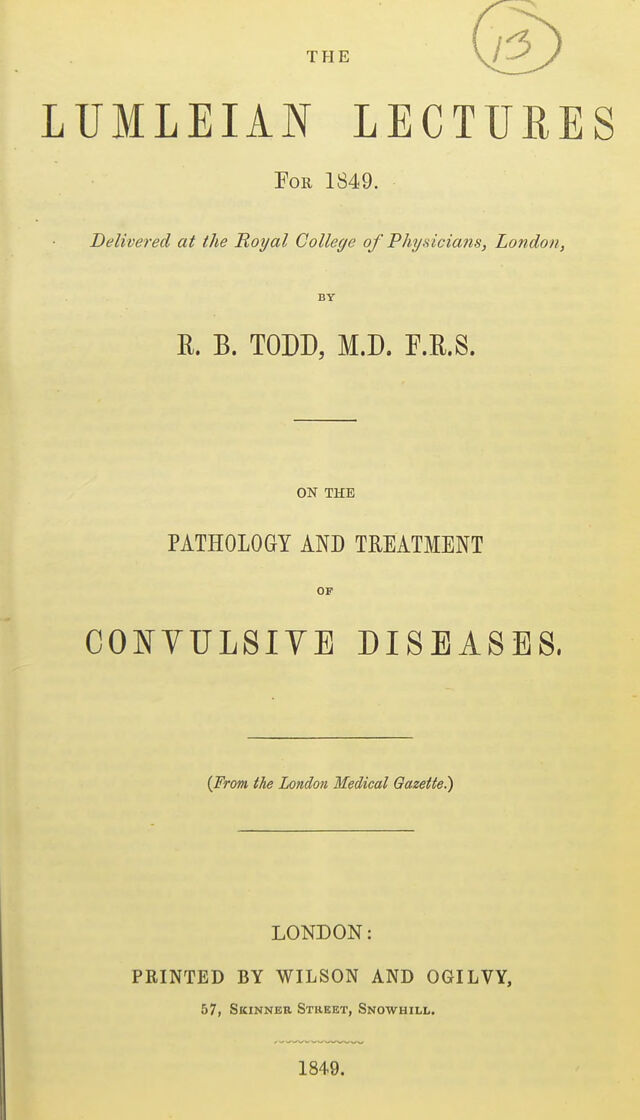
On the pathology and treatment of convulsive diseases / [by R. B. Todd].
- Robert Bentley Todd
- Date:
- 1849
Licence: Public Domain Mark
Credit: On the pathology and treatment of convulsive diseases / [by R. B. Todd]. Source: Wellcome Collection.
Provider: This material has been provided by The University of Glasgow Library. The original may be consulted at The University of Glasgow Library.
12/47 page 10
![Epilepsy is a disease of all periods of life: it seems not improbable that it may com- mence even in utero, being first developed by some powerful emotion excited in the mother, or due to some other disturbing influence upon the nervous system of the embryo. Bouchet and Cazanvielh, from sixty-six observations, obtained the following results regarding the periods of life at which epi- lepsy is most apt to occur :—that from birth to 5 years there were 18 epileptics (9 being congenital); from 5 to 10 years, 11 ; to 15, 11 ; to 20, 10 ; to 25, 5 ; to 30, 4 ; to 35, 1 ; to 40, 2; to 45, 1 ; to 55, 0; to 60, 1. A , aralytic state remains sometimes after the epileptic convulsion. This is more par- ticularly the case when the convulsion has affected only one side or one limb : that limb or limbs will remain paralytic for some hours, or even days, after the cessation of the paroxysm, but it will ultimately per- fectly recover. This is a form of paralysis in a great degree analogous to that of chorea. There is an acute form of epilepsy, as there is a chronic form also. The acute form is distinguished by the number and violence of the fits, and the rapidity with which they succeed each other ; so violent are the fits, that they exhaust, and, if long continued, kill the patient. I have seen patients exhibit a rapid succession of fits for a whole day, with intervals of not more than five or ten minutes, and the exhaustion in- duced by them has been so great that I have been forced to give stimulants in large quantities to keep the patient alive. In the chronic form the disease is re- markable for the kind of periodicity which regulates the development of the paroxysms : thus the fit will occur once in 24 hours, or once in 48 hours, or once a week, or once a month, but not with unvarying exactness as to the interval, nor without many disturb- ances to the ordinary rate of its occurrence. Although this periodicity exhibits some ana- logy to that of ague, it wants greatly its precision. Of the tendency to the propagation of epilepsy by hereditary descent there can be no doubt. Cazanvielh and Bouchet make this remarkable statement : 14 epileptic mothers had 58 children : of this number 37 died, the eldest at 14, the rest nearly all of convulsions; 21 were living, of whom 14 were healthy, still young, and 7 already epileptic. Epilepsy seldom kills: in the record of deaths we meet comparatively few deaths from that cause: epileptics die nominally of other diseases : they are liable to tiie vicissi- tudes of other men—accidents, and conse- quent injuries, not unfrequent (and to these their epileptic condition peculiarly exposes them), fevers, diarrhoea, cholera, &c. These dispose of a large number of them ; but a considerable proportion gradually fall into dementia or other forms of insanity, anj then they become classed with the insane. The tendency of epilepsy is to the destruc- tion of the nervous force, in the brain espe- cially, but ultimately throughout the whole cerebro-spinal centres. The earliest indica- tion of the failure of the nervous power is in the weakening of the perceptive powers and of the memory. No doubt the power of atten- tion suffers primarily, and then the retentive faculty becomes damaged. In this way only can we explain the fact that the power of memory for events of recent occurrence suffers first, the patient recjllecticg old events, or facts stored in the mind at a re- mote period, as well as ever. Ultimately, however, the memory of events of all kiuds and at all periods is lost, and the patient becomes fatuous. This failure of the in- tellectual powers takes place the more rapidly as the paroxysms are more frequent and more severe : it will occur more surely where the fits have been accompanied with much mental disturbance or stupor, than where the convulsive character predominates. Frequent attacks of the epileptic vertigo of Esquirol—the petit mat—are in general pretty certain precursors of a state of de- mentia or fatuity. It is an important feature in the clinical history of epilepsy that the fits sometimes cease spontaneously, or without any cause which can be recognised. Many a remedy for epilepsy has acquired the credit of curing the disease, when it has happened to be ex- hibited in a case in which this spontaneous tendency to recovery has manifested itself. Epilepsy and insanity frequently go toge- ther : in some cases the epilepsy precedes, and, as it were, induces the insanity ; in others the insanity has the precedence ; and in a third class the ])atients a;-e insane only for a short time before, and for a short time after, the epileptic paroxysm, and then re- sume a tolerably healthy state of mind until the access of the next paroxysm. A remarkable and most interesting point in the clinical history of epilepsy is that it may go on for a considerable time, even in its most acute form, without the existence of any morbid change in the brain to be re- cognised by our means of examination. IS'othing is more certain than that not only one, but several paroxysms of epilepsy may be induced in a person whose brain and spinal cord present all the ordinary appear- ances of health. The congestion which is apparent in the brains of epileptics, but which is seldom present excepting in those who have died in the fit, or very shortly af.er it, is attributable](https://iiif.wellcomecollection.org/image/b21470819_0012.jp2/full/800%2C/0/default.jpg)


 No text description is available for this image
 No text description is available for this image
 No text description is available for this image