Temperance and teetotalism : an inquiry into the effects of alcoholic drinks on the human system in health and disease.
- William Benjamin Carpenter
- Date:
- 1848
Licence: Public Domain Mark
Credit: Temperance and teetotalism : an inquiry into the effects of alcoholic drinks on the human system in health and disease. Source: Wellcome Collection.
Provider: This material has been provided by The University of Glasgow Library. The original may be consulted at The University of Glasgow Library.
15/32 page 15
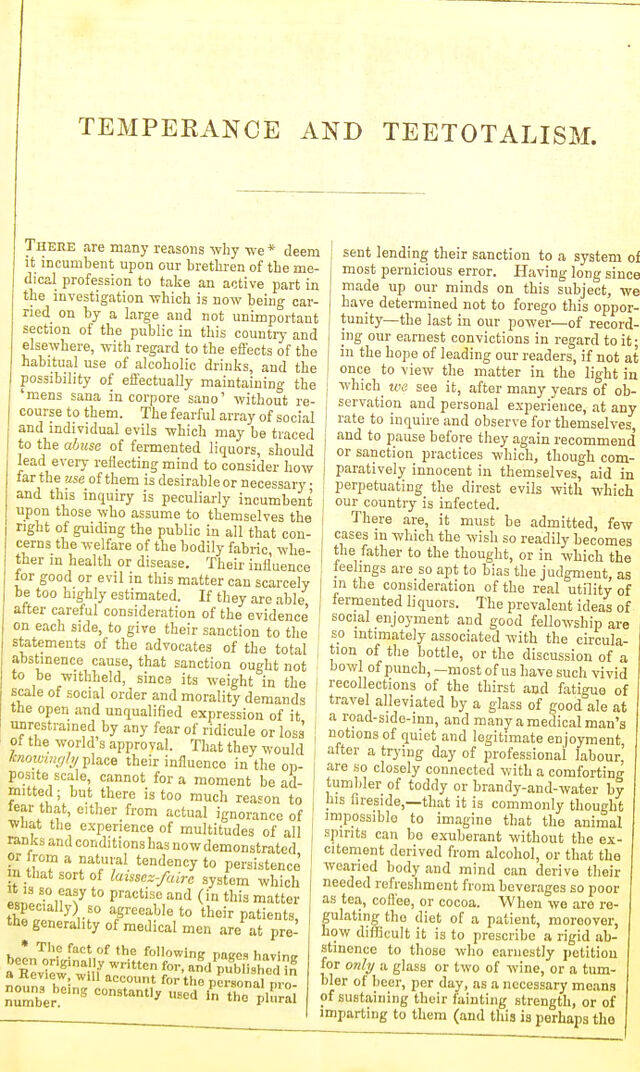
![tbeir habits in regard to the use of alco- holic liquors, and have almost invariably found tliat they had practised extreme moderation, if not total abstinence. All medical men ■who have practised in India agree in attributing the large proportion of cases of severe disease which present themselves among Europeans in that country to the immoderate indulgence in fermented liquors. A statistical proof of it is afforded by the fact quoted by us in a former Number of this Journal (Janu- ary, 1841), in regard to the experience of the British army in Bengal, in which temperance societies (on the old plan of abstinence from distilled spirits only) had been established a few years previously. We must refer to our former abstract for a fuller statement of tlie results of the disuse of ardent spirits, and the diminished consumption of other fermented liquors ; and shall only here state that the returns drawn up by the Inspector-General for the first six mouths of 1838 show that the average daily per centage of sick belong- ing to the Temperance Society (about one third of the whole strength) was only 3|, whilst the daily per centage amongst the remainder was 10 1-Sth. Even this result does not give the most favourable view of the case; for many men joined the tem- perance society whose constitutions had been ruined by previous dissipation, and several such were habitual tenants of the hospital until invalided. Since that time, the total abstinence principle has been in- troduced among Europeans in India and other tropical countries; and, we are as- sured, with the most favourable results. There has been no want of satisfactory medical testimony in its favour. Indeed, all our best writers on tropical diseases are mos't explicit on this point. And we I may here give the evidence recently i given by Mr Gardner, now superintendent j of the Botanic Gardens in Ceylon, a well- i educated surgeon, who spent several years I of most active exertion in Brazil, and who penetrated into that country further than any other scientific European. During three years' travelling in that climate, under constant fatigue and exposure to vicissitudes of weather and irregularity of ; living, his only beverage, besides water, j was tea, of which he had laid in a large I ^ock previously to his departure from ±'ernambuco. He was told when he arrived at Brazil, that he would find it necessary to mix either wine or brandy with the water which he drank; but a very short experience told him, not only that they are unnecessary, but that they are decidedly hurtful to those whose oc- cupations lead them much into the sun. ' Whoever drinks stimulating liquors,' he says, 'and travels day after day in the sun, will certainly suffer from headache; and in countries where miasmata prevail, he will be far more likely to be attacked by the diseases which are there endemic' [See Adde7iduin, 28th page.] Now this testimony, from those who have tried the experiment of total abstin- ence in tropical climates, and who have watched its results in others, must surely be regarded as of greater weight than any vague notion to the contrary, however prevalent such notion may be; more especially as it corresponds exactly with what might be predicated upon scientific grounds. For, as we have already shown, the introduction of alcohol into the blood obstructs its depuration by the respiratory process ; more especially when the sur- rounding temperature is high, and the natural exhalation of carbonic acid is con- sequently diminished. Hence the system is subjected to the injurious influences of an imperfectly decarbonized and aerated blood; and the liver is called upon to do what the lungs are prevented from effecting, —the foundation being thus laid, in the habitual stimulation of the liver to undue functional activity, of inflammatory disease in that organ. The testimony of those who are exposed to vicissitudes of climate is perhaps even more valuable than that of those who have to sustain continued heat or severe cold; and under this aspect we regard the evidence of intelligent seamen as of pe- culiar importance, in addition to the force it derives from the well-known attach- ment of their class to spirituous liquors. That such regard the total abstinence principle as at any rate a safe one, may be inferred from the circumstance that it is now carried into practice in a very con- siderable part of the merchant service in this country, and in a still larger propor- tion of American vessels ; and that the adoption of this plan is not known to occasion any difficulty in obtaining crews for the 'temperance ships,' when a fair compensation is made in the superior quality of the provisions and allowances, or in the rate of wages, as an equivalent for the • stopping of the grog;' in fact,](https://iiif.wellcomecollection.org/image/b21450742_0017.jp2/full/800%2C/0/default.jpg)