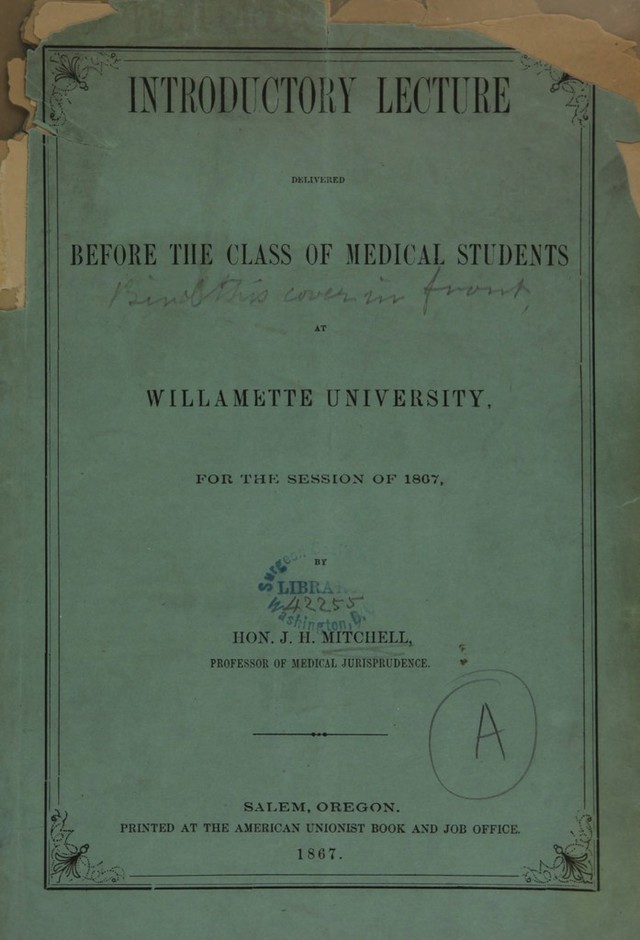
Introductory lecture delivered before the class of medical students at Willamette University : for the session of 1867 / by J.H. Mitchell.
- John H. Mitchell
- Date:
- 1867
Licence: Public Domain Mark
Credit: Introductory lecture delivered before the class of medical students at Willamette University : for the session of 1867 / by J.H. Mitchell. Source: Wellcome Collection.
Provider: This material has been provided by the National Library of Medicine (U.S.), through the Medical Heritage Library. The original may be consulted at the National Library of Medicine (U.S.)
10/16
![• Hey are found acting with ordinary skill, in good and with reasonable care, will ever find full and complete protection, an tioa without stint beneath its ample and protecting folds. the law, therefore, prescribes no particular :. every ph; xpccted to practice ac- i wliich be professes, and in which he avows himself to the community to be competent. It is competent, therefore, for a phy- sician, charged with malpractice, to show that his treatment of the case was in accordance with the cd. and which it was known he followed : provided he adheres to any one of the of practice that are generally :i and recognized by the scientific world, and HOt t . fanciful, and perhaps dangerous recent origin, and which is not known lo the world or understood, or recognized by men ence And if he can show this, and it appears lhutbehas< rdinary cai liable: and it would be no answer, nor would it be per- i. for the plaintiff in the action lo prove that the treatment of the ca direct conflict with that prescribed by some other school as, which it is admitted the defendant ■ever i I or professed to follow. Tor in- stance : You hold, we will say for the illustration, te ll.e system of allopathy. You are called to see a patient laboring under a severe attack of fever. You immediately prescribe those remedies and that general course of treatment which, in your judgment, and which, according to your (h allopathic treatment, will produce in the system of your patient a condition incompatible with that condition essential to the existence of the particu- lar fever. At all events, you follow the . your bf ok-. You have proceeded, in all respects, in accordance with the school of practice to you belong, and which you prof< rstand. But, still, for some reason, the fe, gradually increases in its malignancy, and. in a brief space of time, your patient suddenly The father of the deceased immediately comn x civil inst you. for the purpose of recovering damages for the . which he I f his child's death, lie charges, in his com- plaint, thai course tically wroi ion, he callsiipon the witness stand a homeopathiat. And, in answer to tb< tion, as to whether your treatment waa proper for raeh a fever, he answers at once that it was not. And if asked why it was not. he will answer that, to attempt to produce such a condition of the hu- man bj wholly inc with the ex- istence of the fever, is a piece of sheer folly ; that it is an idea, long since exploded, and Qtific practitioner will entertain for a moment. And if asked further what the treatment of the case should have been, he wiil proceed, doubtless, to say that like kills like, and that a course of treatment just the reverse of that pur- sued by you should have been prescribed, which would have tended to produce in the patient affec- tions similar to those of the fever. Now, you can see at a glance, that it would be a dangerous principle in legal jurisprudence ould allow you to be condemned upon a s of evidence such as this. And it would be cgious error in any court that would charge a jury in such a case that, if they believed from all the testimony that your treatment w ;. and thai it should i; :ii:g to that they should then find for the plaintiff. Upon the contrary, the charge in such a My should be, in substance and effect, this: What system of practice did the de- fendant adhere to? is that sy stem one among the many that is recognized by the scientific world? Was the treatment in accordar.ee with that system? and did he exercise ordinary care ? ]f so, the ver- dict should be for the defem ugh the jury might be fully convinced that death, in this partic- ular case, was the result of the treatment. lii determining the question, however, as to what is ordinary skill, courts will lake into consid- eration the advanced state of the profession, in the ilar system brought in question, at the time of the alleged malpractice, as it is very manifest that what would amount to ordinary skill in almost any science or profession a century ago would fall very far short of coming up lo that standard at the at day. While it is true, therefor, that the paws no distinction in this State between the regular and irregular practitioner—between the ignorant charlatan and the thoroughly educated 'an- by saying that the one may engage in practice and the other shall not, still, when a man- sets himself up as a practitioner in any system of o, and advertises, and holds himself out to amunity and the world, as a person compe- tent to deal with the physical accidents and infirm- f the race, he must, when occasion requires his services, and he voluntarily undertakes the case, be able to bring to his aid at least ordinary](https://iiif.wellcomecollection.org/image/b21141654_0010.jp2/full/800%2C/0/default.jpg)