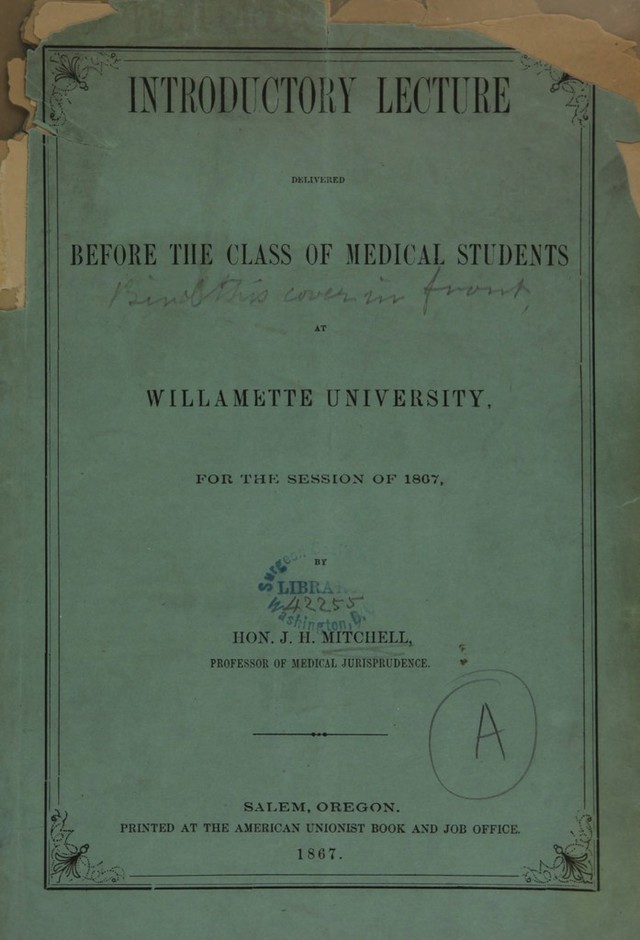
Introductory lecture delivered before the class of medical students at Willamette University : for the session of 1867 / by J.H. Mitchell.
- John H. Mitchell
- Date:
- 1867
Licence: Public Domain Mark
Credit: Introductory lecture delivered before the class of medical students at Willamette University : for the session of 1867 / by J.H. Mitchell. Source: Wellcome Collection.
Provider: This material has been provided by the National Library of Medicine (U.S.), through the Medical Heritage Library. The original may be consulted at the National Library of Medicine (U.S.)
11/16
![K flail in (he particular system in which he attempts to prai therwise, ii' injury follows, ho is -guilty of medical malpractice, and he must Buffer --the consequences. I mean civilly, by responding in damages to such an amount as a jury may esti- mate the injury sustained —even although that be to the value of an arm, a leg. an eye, or even life itself. The plaintiff, in an action against a practitioner for malpractice, must be able to prove—because the onus of proof in such cases is always upon the plaintiff—that the defendant has set aside the es- tablished principles, and neglected to employ means which are, by medical writers and qualified practitioners, universally Isold to be necessary in the particular case under consideration, or that he has employed means in the treatment of the which are, by competent medical writers and prac- titioners, universally held to be improper and dan- gerous. This is a rule, however, as I have already stated, that must be considered with reference to the particular system which he professes to follow. For the law has, ^through judicial sanction, very wisely established the doctrine that, if a man em- ploys, Tor instance, an homeopathist, knowing him to be such, and be is injured through malpractice, he will not be permitted to show, as a foundation for damages, that the treatment was not in accord- ance with the universally established treatment in a like case of the allopathists, or any other, or in fact all other systems, and vice versa. But the same degree of want of skill and reason- able care which will subject a practitioner to a civil liability for damages, will not subject him to an indictment for a felony or a misdemeanor. The law in this regard is tenderly careful of the profes- sion, and it requires a case showing, not only a ■want of ordinary skill and reasonable care, but ol ■either gross ignorance or gross negligence. And in this respect, also, has the Jurisprudence of this country and England undergone a radical change since the times of Lord Coke, wiiose Institutes were written over two hundred years ago. During his day, the records of the English criminal courts show at least quite numerous instances of practi- tioners having been, for malpractice, condemned and executed for manslaughter—manslaughter, at that day in England, being a capital offence. The law, however, as I have already intimated, of the present day in the United States—except in certain States where it is regulated by statute (and it is also the same in England)—is this : Thai, in order to subject a practitioner to a criminal prosecution for malpractice, it must be made to appear, either that'ee was grossly ignorant, or, that not being so grossly ignorant, he was guilty of gross negligence. And 1 will here state that this general doctrine of the common law has been incorporated into the criminal code of Oregon. Section 587 of the code of Criminal Procedure, page 528 of the General Laws of Oregon, as compiled and annotated bj Judge M. P. Deady, provides as follows : '•If any person shall, in the commission of an un- lawful act. or a lawful act, without due caution or circumspection, involuntarily kill another, such person shall be deemed guilty of manslaughter. Again : Section 519, on page r>:50, of the same code, reads as follows : '•The killing of a human being is excusable when committed - '•1st. By accident or misfortune, in lawfully correcting a child or servant, or in doing any other lawful act by lawful means, with usual and ordin- ary caution, and without any unlawful in And again, section 510 of same provides that If any physician, while in a state of intoxica- tion, shall, without a design to effect death, admin- ister any poison, drug, or medicine, or do an] er act to another person which shall produce the death of such other, such physiciun .shall be deemed guilty of man daughter.'1 These wholesome statutory provisions are, how- ever, in the main, merely declaratory of what the law had long since become by the many uniform decisions from the judicial bench. If, therefore, a person is employed to act in a given case, either as a physician or surgeon— whether he be a regular practitioner or not—if he acts honestly and soberly, uses his best skill to cure, is not grossly ignorant, or has not been guilty of gross negligence, he is not criminally responsi- ble, no matter wha&the result itmcnl may lie. Sou will perceive, therefore, that, while dam- ages may be recovered against a] er for mere want of medical skill, ho cannot, for Che same reason, be held criminally liable in a prosecution. And even under the English ! e centuries ago. which recognized the distinction between the regular and irregular practiri which pro- hibited a person from practl tnt a pre- scribed diploma, while a pi foiled might be subjected to a penalty in a quasi crim- inal prosecution, he was not answerable crimin- ally for murder or manslaughter on thai a alone. A practitioner, however, at th whether he be regularly educated or not— may be criminally liable for m ier he is or not, in any given case, must depend entirety](https://iiif.wellcomecollection.org/image/b21141654_0011.jp2/full/800%2C/0/default.jpg)