Improvements in or connected with hypodermic syringes / [James Ernest Arnold].
- Arnold, James Ernest.
- Date:
- 1904
Licence: Public Domain Mark
Credit: Improvements in or connected with hypodermic syringes / [James Ernest Arnold]. Source: Wellcome Collection.
2/6 page 2
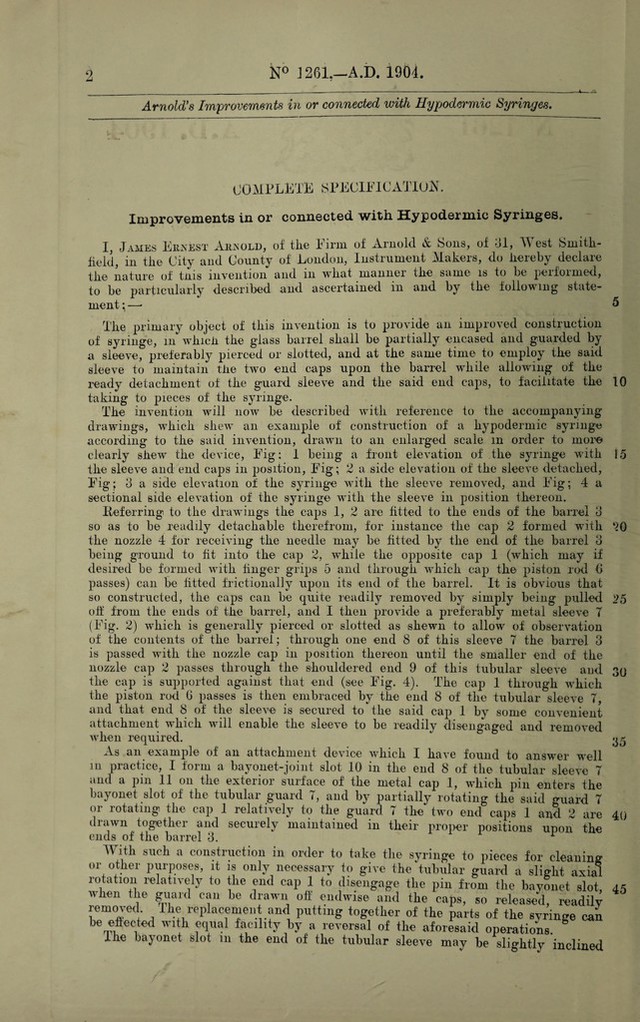
![_______;-----i. Arnold’s Improvements in or connected with Hypodermic Syringes. COMPLETE SPECIFICATION. Improvements in or connected with Hypodermic Syringes. I, James Ernest Arnold, of the Firm of Arnold & Sons, of 31, West Smitli- fiekl, in the City and County of London, Instrument Makers, do hereby declare the nature of tins invention and m what manner the same is to be peifoimed, to be particularly described and ascertained in and by the following state¬ ment ; —• 5 The primary object of this invention is to provide an improved construction of syringe, in which the glass barrel shall be partially encased and guarded by a sleeve, preferably pierced or slotted, and at the same time to employ the said sleeve to maintain the two end caps upon the barrel while allowing of the ready detachment of the guard sleeve and the said end caps, to facilitate the 10 taking to pieces of the syringe. The invention will now be described with reference to the accompanying drawings, which shew an example of construction of a hypodermic syringe according to the said invention, drawn to an enlarged scale m order to more clearly shew the device, Fig: 1 being a front elevation of the syringe with 15 the sleeve and end caps in position, Fig; 2 a side elevation of the sleeve detached, Fig; 3 a side elevation of the syringe with the sleeve removed, and Fig; 4 a sectional side elevation of the syringe with the sleeve in position thereon. Referring to the drawings the caps 1, 2 are fitted to the ends of the barrel 3 so as to be readily detachable therefrom, for instance the cap 2 formed with 20 the nozzle 4 for receiving the needle may be fitted by the end of the barrel 3 being ground to fit into the cap 2, while the opposite cap 1 (which may if desired be formed with finger grips 5 and through which cap the piston rod 6 passes) can be fitted frictional]y upon its end of the barrel. It is obvious that so constructed, the caps can be quite readily removed by simply being pulled 25 off from the ends of the barrel, and I then provide a preferably metal sleeve T (Fig. 2) which is generally pierced or slotted as shewn to allow of observation of the contents of the barrel; through one end 8 of this sleeve 7 the barrel 3 is passed with the nozzle cap in position thereon until the smaller end of the nozzle cap 2 passes through the shouldered end 9 of this tubular sleeve and 30 the cap is supported against that end (see Fig. 4). The cap 1 through which the piston rod 6 passes is then embraced by the end 8 of the tubular sleeve 7, and that end 8 of the sleeve is secured to the said cap 1 by some convenient attachment which will enable the sleeve to be readily disengaged and removed when required. 05 As an example of an attachment device which I have found to answer well in practice, I form a bayonet-joint slot 10 in the end 8 of the tubular sleeve 7 . —' * %/ c. J — ^ V'V j J M _JL_ V4 V4. ^ ^ | j drawn together and securely maintained in their proper positions upon the ends of the barrel 3. r With such a construction in order to take the syringe to pieces for cleaning or other purposes, it is only necessary to give the tubular guard a slight axial rotation relatively to the end cap 1 to disengage the pin from the bayonet slot, 45 nhen the guard can be drawn off endwise and the caps, so released, readily removed Ihe replacement and putting together of the parts of the syringe can be eftected with equal facility by a reversal of the aforesaid operations. I he bayonet slot in the end of the tubular sleeve may be slightly inclined /](https://iiif.wellcomecollection.org/image/b30740848_0002.jp2/full/800%2C/0/default.jpg)