On underground temperatures : with observations on the conductivity of rocks, on the thermal effects of saturation and imbibition, and on a special source of heat in mountain ranges / by Joseph Prestwich.
- Joseph Prestwich
- Date:
- 1886
Licence: Public Domain Mark
Credit: On underground temperatures : with observations on the conductivity of rocks, on the thermal effects of saturation and imbibition, and on a special source of heat in mountain ranges / by Joseph Prestwich. Source: Wellcome Collection.
Provider: This material has been provided by The Royal College of Surgeons of England. The original may be consulted at The Royal College of Surgeons of England.
21/122 (page 17)
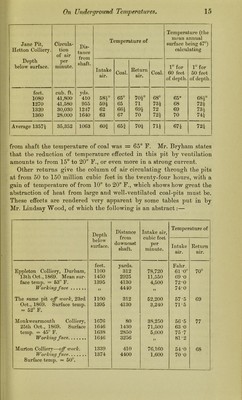
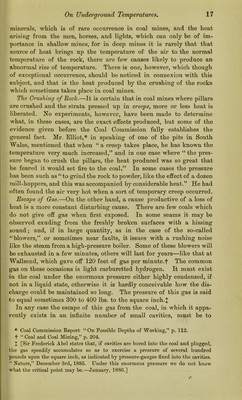
![minerals, which is of rare occurrence in coal mines, and the heat arising from the men, horses, and lights, which can only be of im- portance in shallow mines, for in deep mines it is rarely that that source of heat brings up the temperature of the air to the normal temperature of the rock, there are few causes likely to produce an abnormal rise of temperature. There is one, however, which though of exceptional occurrence, should be noticed in connexion with this subject, and that is the heat produced by the crushing of the rocks which sometimes takes place in coal mines. The Crushing of Boch.—It is certain that in coal mines where pillars are crushed and the strata pressed up in creeps^ more or less heat is liberated. No experiments, however, have been made to determine what, in these cases, are the exact effects produced, but some of tho evidence given before the Coal Commission fally establishes the general fact. Mr. Elliot,* in speaking of one of the pits in South Wales, mentioned that when “ a creep takes place, he has known the temperature very much increased,” and in one case where “ the pres- sure began to crush the pillars, the heat produced was so great that he feared it would set fire to the coal.” In some cases the pressure has been such as “to grind the rock to powder, like the effect of a dozen mill-hoppers, and this was accompanied by considerable heat.” He had often found the air very hot when a sort of temporary creep occurred. Escape of Gas.—On the other hand, a cause productive of a loss of heat is a more constant disturbing cause. There are few coals which do not give off gas when first exposed. In some seams it may be observed exuding from the freshly broken surfaces with a hissing sound; and, if in large quantity, as in the case of the so-called “blowers,” or sometimes near faults, it issues with a rushing noise like the steam from a high-pressure boiler. Some of these blowers will be exhausted in a few minutes, others will last for years—like that at Wallsend, which gave off 120 feet of gas per minute.f The common gas on these occasions is light carburetted hydrogen. It must exist in the coal under the enormous pressure either highly condensed, if not in a liquid state, otherwise it is hardly conceivable how the dis- charge could be maintained so long. The pressure of this gas is said to equal sometimes 300 to 400 lbs. to the square inch.;|; In any case the escape of this gas from the coal, in which it appa- rently exists in an infinite number of small cavities, must be to * Coal Commission Report “On Possible Depths of Working,” p. 112. t “ Coal and Coal Mining,” p. 204. X [Sir Frederick Abel states that, if cavities are bored into the coal and plugged, the gas speedily accumulates so as to exercise a pressure of several hundred pounds upon the square inch, as indicated by pressure-gauges fixed into the cavities. “ Nature,” December 3rd, 1885. Under this enormous pressure we do not know what the critical point may be.—January, 1886.] r](https://iiif.wellcomecollection.org/image/b22446163_0023.jp2/full/800%2C/0/default.jpg)