An act (8 & 9 Vict. c. 100) for the regulation of the care and treatment of lunatics. With explanatory notes ['A history of the legislation on ... lunacy'], etc., and comments / Edited by Forbes Winslow, M.D.
- Forbes Benignus Winslow
- Date:
- 1845
Licence: Public Domain Mark
Credit: An act (8 & 9 Vict. c. 100) for the regulation of the care and treatment of lunatics. With explanatory notes ['A history of the legislation on ... lunacy'], etc., and comments / Edited by Forbes Winslow, M.D. Source: Wellcome Collection.
146/192 page 134
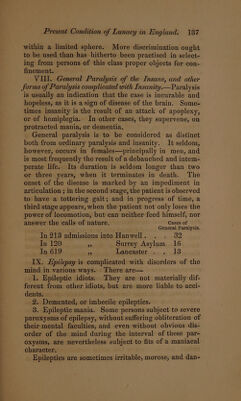
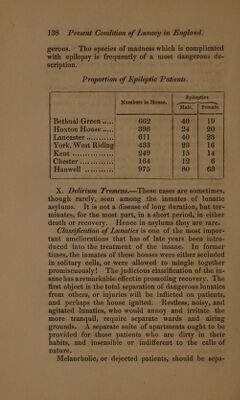
![II. Dementia, or decay and obliteration of the intellectual faculties. Il]. Melancholia. IV. Monomania. V. Moral Insanity. - The three last mentioned forms are sometimes com- prehended under the term Partial Insanity. VI. Congenital Idiocy. VII. Congenital Imbecility. VIII. General Paralysis of the Insane. Epilepsy. | To these may be added Delirium Tremens. I. Mania.—This term is used to designate a par- ticular kind of madness, as affecting all the operations of the mind. Maniacs are incapable of carrying on, in a calm and collected manner, any process of thought —their disorder betrays itself in conversation, conduct, gesture, and behaviour, which are absurd and irra- tional. It is also accompanied by hurry and confusion of ideas, and by more or less excitement of feeling and expression. This in excessive degree is termed 1. Mania, or Raving Madness.—This is often the first stage of the disease, which often becomes gra- dually milder in its character. In other cases, the raving state continues throughout the whole of the disease, and becomes fatal through the consequent exhaustion and want of rest. Itis also attended with considerable disturbance of the vital functions. 2. Chronic Mania.— This is attended with less excitement of the passions, less rapidity of utterance, and violence of action. The disorder of the mind in this stage is not always perceptible, but it soon be- comes apparent that the patient is incapable of con- tinued rational conversation or self-control. A great proportion of these cases labour under hallucinations and illusions, or false impressions as to matters of fact, but they are often tranquil and harmless. Many of them are capable of being employed in agricultural](https://iiif.wellcomecollection.org/image/b2879526x_0146.jp2/full/800%2C/0/default.jpg)