A new system of teeth regulation with finely made original devices ready for immediate operative application without soldering / by Miland A. Knapp.
- Knapp, Miland Austin, 1868-
- Date:
- [1901], ©1901
Licence: Public Domain Mark
Credit: A new system of teeth regulation with finely made original devices ready for immediate operative application without soldering / by Miland A. Knapp. Source: Wellcome Collection.
Provider: This material has been provided by the Augustus C. Long Health Sciences Library at Columbia University and Columbia University Libraries/Information Services, through the Medical Heritage Library. The original may be consulted at the the Augustus C. Long Health Sciences Library at Columbia University and Columbia University.
9/34 (page 5)
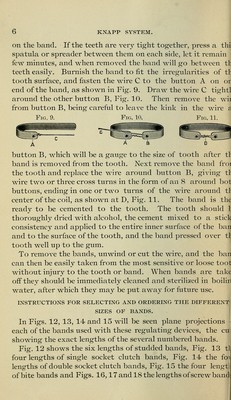
![buttons to nearly touch becomes necessaiy, as in Fig-. 4, ich is an illustration of a studded band No. 4. To meet all [se peculiarities, the bands are made in ten sizes. THE STUDDED BANDS. 'igs. 1 and 4 sIioav the studded band Avith the threaded stud the side opposite from the buttons. To this stud is attach- the ball cap of the jack-screw, the stud bar and nut, or the aining devices. THE CLUTCH BANDS. 'he clutch consists of a slotted tube attached to the band the side op])osite from the buttons or screw. See Fig. 5. is receives and holds firmly the iinchorage portions of all the 'ices used in these appliances, and allows them to be easily i quickly removed and replaced Avithout removing the bands the clutch nuts from the bars. This last advantage will be y appreciated by every dentist who has had to place a nut a bar or wire after passing it through a tube or pipe fixed a tooth-band in the mouth. He Avill well remember his )rts to put nuts on traction bars or wire arch bars protrud- ^ from the distal ends of tubes on molar teeth. in enlarged drawing of the clutch tube of the double socket tell bands, Nos. 7 to 10 and 49 to 52, is shown in Fig. 6. A he band to which the partial tube B is attached. D is the t Avhich receives the threaded bar. CC are enlarged portions sockets Avhich receive the cylindrical portions of the clutch ts. When the nuts are in position the threaded bar is held nly in the tube, as shown in Fig. 8. Fig. 5, Fig. G. Fig. 7. B X(l. 2-'. I Fig. 8. € ?ig. 7 shows the clutch nut, the round- portion of \vhich fits into the socket C C of the clutch tube B, Fig. 6. TO APPLY THE BANDS. select a band of the proper size, and carefully work it on ound the tooth to be banded. Do not use a mallet or pound](https://iiif.wellcomecollection.org/image/b21216289_0009.jp2/full/800%2C/0/default.jpg)