The synthetical preparation of the d-glucosides of sitosterol, cholesterol, and some fatty alcohols / by Arthur H. Salway.
- Salway, Arthur H. (Arthur Henry)
- Date:
- [1913?]
Licence: Public Domain Mark
Credit: The synthetical preparation of the d-glucosides of sitosterol, cholesterol, and some fatty alcohols / by Arthur H. Salway. Source: Wellcome Collection.
4/12 page 1023
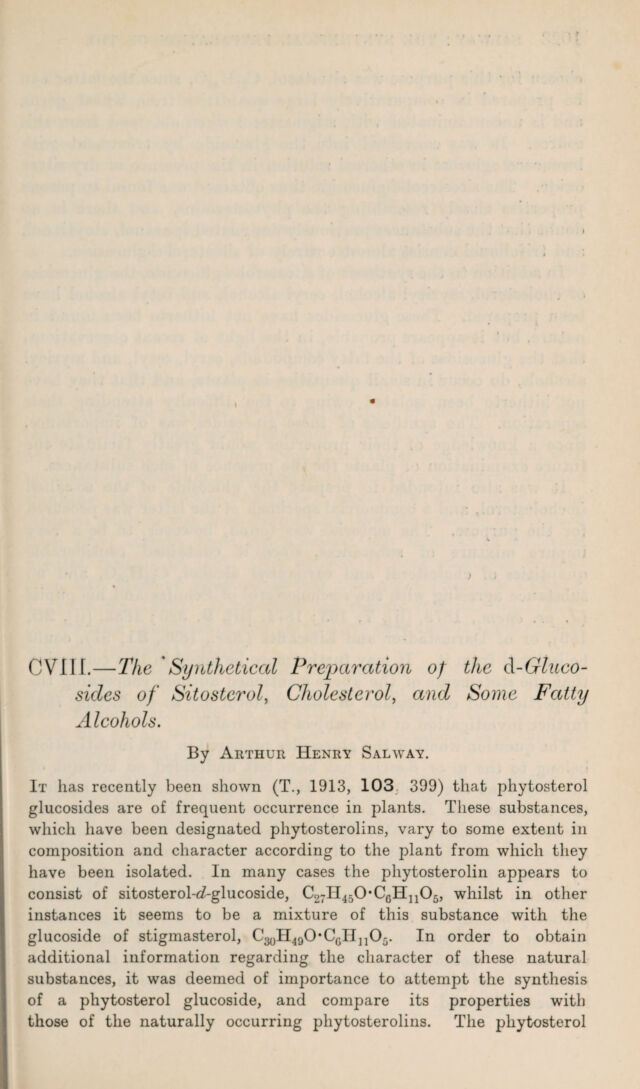
![chosen for this purpose was sitosterol, C27H460, since the latter can be prepared in comparatively large quantities from wheat germ, and is uncontaminated with stigmasterol when obtained from this source. It was converted into the glucoside by treatment with bromoacetoglucose in ethereal solution in the presence of dry silver oxide. The sitosterol-6?-glucoside thus obtained was found to possess properties closely resembling the phytosterolins, and there is no doubt that the substances previously designated ipuranol, cluytianol, and trifolianol consist almost entirely of sitosterol-<7-glucoside. In addition to the synthesis of sitosterol-<7-glucoside, the glucosides of cholesterol, myricyl alcohol, ceryl alcohol, and cetyl alcohol have been prepared. These glucosides have not hitherto been found in nature, but it appears probable, in the light of recent observations, that the glucosides of the fatty compounds, ceryl, cetyl, and myricyl alcohols, do occur in small quantities in plants, and that they have not hitherto been isolated owing to the difficulty attending their separation. The synthesis of these glucosides was of importance, since a knowledge of their properties would greatly facilitate the future examination of plants for the presence of such substances. It was also intended to prepare the glucoside of the so-called iso cholesterol, and a commercial specimen of the latter was procured for the purpose. The material was found, however, to be a very impure mixture of substances, since it contained considerable quantities of cholesterol and carnaubyl alcohol, C24H50O, and no substance agreeing with the isocholesterol of Schulze and his pupils (J. pr. chem., 1873, [ii], 7, 163; 1874, [ii], 9, 325; 1882, [ii], 25, 159), or of D_armstadter and Lifschiitz (Ber., 1898, 31, 97), could be isolated from it. It may furthermore be noted in this connexion that the statements of the above-mentioned authors concerning the properties and composition of isocholesterol are so conflicting that further investigation of the subject is desirable. The question whether the glucosides prepared in this investigation belong to the a- or /3-series has been left undecided on account of the fact that the insolubility of these substances in water renders the emulsion test for a- and /3-glucosides indecisive. Fischer and Helferich (Annalen, 1911, 383, 68) have shown, however, that in almost all cases the method of preparation of glucosides described by them, and adopted in the present investigation, leads to the formation of /3-glucosides, so that the glucosides now obtained probably belong also to this series. In the case of ceryl-^-glucoside, however, it is of interest to note that the present author has isolated two distinct modifications, which may possibly represent the a- and /3-forms of the glucoside, although no definite evidence to this effect has been obtained.](https://iiif.wellcomecollection.org/image/b30620375_0004.jp2/full/800%2C/0/default.jpg)