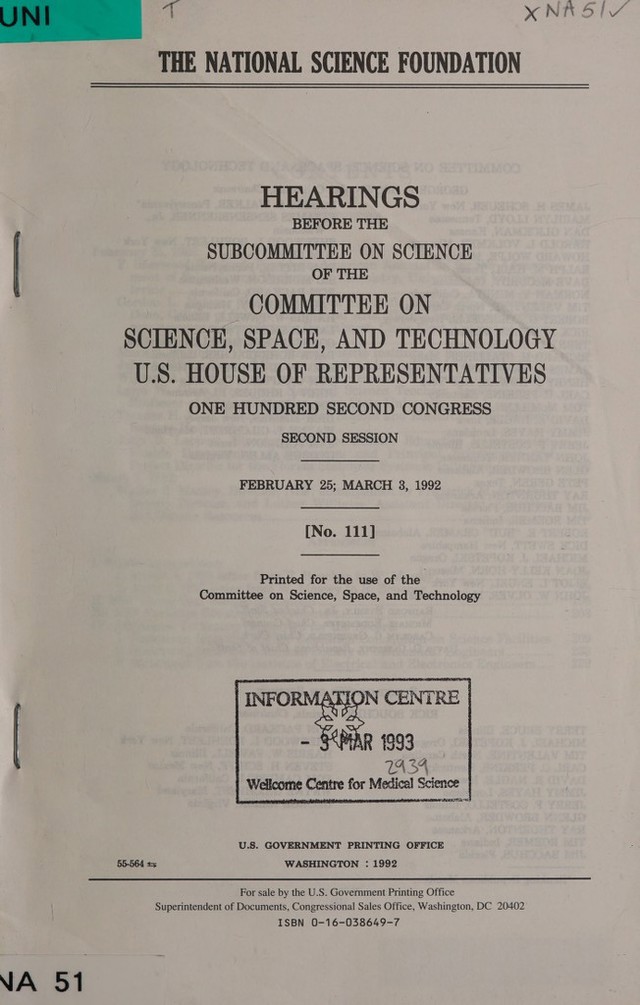
The National Science Foundation : hearings before the Subcommittee on Science of the Committee on Science, Space, and Technology, U.S. House of Representatives, One Hundred Second Congress, second session, February 25; March 3, 1992.
- United States. Congress. House. Committee on Science, Space, and Technology. Subcommittee on Science
- Date:
- 1992
Licence: Public Domain Mark
Credit: The National Science Foundation : hearings before the Subcommittee on Science of the Committee on Science, Space, and Technology, U.S. House of Representatives, One Hundred Second Congress, second session, February 25; March 3, 1992. Source: Wellcome Collection.
5/248 page 1
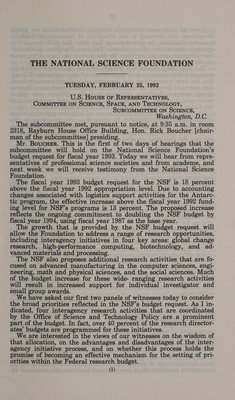
![THE NATIONAL SCIENCE FOUNDATION TUESDAY, FEBRUARY 25, 1992 U.S. Houser oF REPRESENTATIVES, COMMITTEE ON SCIENCE, SPACE, AND TECHNOLOGY, SUBCOMMITTEE ON SCIENCE, Washington, D.C. The subcommittee met, pursuant to notice, at 9:35 a.m. in room 2318, Rayburn House Office Building, Hon. Rick Boucher [chair- man of the subcommittee] presiding. Mr. BoucuHEr. This is the first of two days of hearings that the subcommittee will hold on the National Science Foundation’s budget request for fiscal year 1993. Today we will hear from repre- sentatives of professional science societies and from academe, and next week we will receive testimony from the National Science Foundation. The fiscal year 1993 budget request for the NSF is 18 percent above the fiscal year 1992 appropriation level. Due to accounting changes associated with logistics support activities for the Antarc- tic program, the effective increase above the fiscal year 1992 fund- ing level for NSF’s programs is 13 percent. The proposed increase reflects the ongoing commitment to doubling the NSF budget by fiscal year 1994, using fiscal year 1987 as the base year. The growth that is provided by the NSF budget request will allow the Foundation to address a range of research opportunities, including interagency initiatives in four key areas: global change research, high-performance computing, biotechnology, and ad- vanced materials and processing. The NSF also proposes additional research activities that are fo- cused on advanced manufacturing in the computer sciences, engi- neering, math and physical sciences, and the social sciences. Much of the budget increase for these wide- ranging research activities will result in increased support for individual investigator and small group awards. We have asked our first two panels of witnesses today to consider the broad priorities reflected in the NSF’s budget request. As I in- dicated, four interagency research activities that are coordinated by the Office of Science and Technology Policy are a prominent part of the budget. In fact, over 40 percent of the research director- ates’ budgets are programmed for these initiatives. We are interested in the views of our witnesses on the wisdom of that allocation, on the advantages and disadvantages of the inter- agency initiative process, and on whether this process holds the promise of becoming an effective mechanism for the setting of pri- orities within the Federal research budget.](https://iiif.wellcomecollection.org/image/b32218205_0005.jp2/full/800%2C/0/default.jpg)