I. The mechanism of dislocations and fracture of the hip : II. Litholapaxy, or, Rapid lithotrity with evacuation / by Henry Jacob Bigelow.
- Henry Jacob Bigelow
- Date:
- 1900
Licence: Public Domain Mark
Credit: I. The mechanism of dislocations and fracture of the hip : II. Litholapaxy, or, Rapid lithotrity with evacuation / by Henry Jacob Bigelow. Source: Wellcome Collection.
Provider: This material has been provided by the Francis A. Countway Library of Medicine, through the Medical Heritage Library. The original may be consulted at the Francis A. Countway Library of Medicine, Harvard Medical School.
33/376 page 19
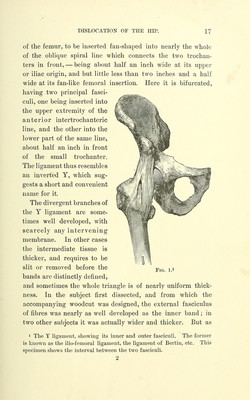
![''It [the ligament] is very thick between the anterior inferior spine of the os ilium all the way to the small anterior tuberosity which unites, as it were, the basis of the great trochanter with the basis of the neck. It is likewise very thick between the same spine and the middle part of the oblique rough line observable between the tuberosity and the little trochanter; and here likewise it is strengthened by a bundle of fibres connected to the passage of the tendon of the iliac muscle and to the inferior portion of the oblique rough line. The disposition of the ligamentous fibres of which these two thick portions are composed forms a sort of triangle with the oblique rough line which terminates the basis of the neck. ^ Weitbrecht, an excellent, perhaps the best, authority up- on the ligaments, referring in this connection to Winslow, distinctly recognizes a forked arrangement, which he thus describes : — Partim anterius versus collum femoris et trochanterem mino- rem procedit, . . . partim vero lateraliter versus exteriora progre- ditur, et circa radicem trochanteris majoris in tuberculo laterali terminatur. Atque binae hae divaricationes, una cum linea obli- qua, figuram . . . triangularem . . . constituunt. ^ The Webers describe the ligament as triangular, laying stress upon its thickness, which, as they assert, is greater than that of the ligament of the patella or the tendo Achillis, and concluding thus : — ''With this great strength we should expect that every other part of the capsule would be ruptured before this ligament; and that even the bone itself would first yield. ^ ^ An Anatomical Exposition of the Structure of the Human Body (sect. 2, pp. 138-139). By James Benignus Winslow. (Douglas's Trans- lation.) London, 1776. 2 Syndesmologia, sive Historia Ligamentorum, etc. (p. 141). Josias Weitbrecht, D. M. Petropoli, 1742. 3 Traite d'Osteologie, etc. (pp. 323, 324). S. P. Soemmerring, and G. and E. Weber. Paris, 1843.](https://iiif.wellcomecollection.org/image/b21041969_0033.jp2/full/800%2C/0/default.jpg)
 No text description is available for this image
 No text description is available for this image
 No text description is available for this image