[Report 1932] / School Medical Officer, Somerset County Council.
- Somerset Council
- Date:
- 1932
Licence: Attribution 4.0 International (CC BY 4.0)
Credit: [Report 1932] / School Medical Officer, Somerset County Council. Source: Wellcome Collection.
21/52 (page 19)
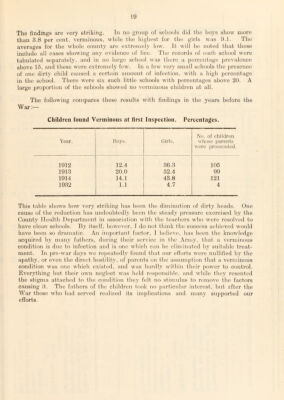
![The findings ;U‘e very striking. In no group of scliools did the hoys show more than 3.8 per cent, verminous, while the liighest for the girls was 9.1. The averages for the whole county are extremely low. It will he noted that these include all cases showing any evidence of lice. 'Jdie records of each school were tabulated separately, aud iu no large school was there a percentage prevalence above 15, and these were extremely few. In a few very small schools the })resence of one dirty child caused a certain amount of infection, with a high percentage in the school. There were six such little schools with percentages above 20. A large proportion of the schools showed no verminous children at all. The following compares these results with findings in the years before the War;— Children found Verminous at first Inspection. Percentages. Year. Roys. Tiirls. No. of children uhose i>arents were i)roseculed. 1912 12.4 36.3 105 1913 20.0 52.4 99 1914 14.1 43.8 121 1932 1.1 4.7 4 This table shows how very striking has been the diminution of dirty heads. One cause of the reduction has undoubtedly been the steady pressure exercised by the County Health Department in association with the teachers who were resolved to have clean schools. By itself, however, T do not think the success achieved would have been so dramatic. An important factor, I believe, has been the knowledge acquired by many fathers, during their service in the Army, that a verminous condition is due to infection and is one which can be eliminated by suitable treat¬ ment. In pre-war days we re])eatedly found that our efforts were nullified by the apathy, or even the direct hostility, of parents on the assumption that a verminous condition was one which existed, and was hardly within their power to control. Everything but their own neglect was held res])onsihle, and while they resented the stigma attached to the condition they felt no stimulus to remove the factors causing it. The fathers of the children took no ]urrticular interest, hut after the War those who had served realized its im])lications and many supported our efforts.](https://iiif.wellcomecollection.org/image/b30112266_0023.jp2/full/800%2C/0/default.jpg)