[Report 1932] / School Medical Officer, Somerset County Council.
- Somerset Council
- Date:
- 1932
Licence: Attribution 4.0 International (CC BY 4.0)
Credit: [Report 1932] / School Medical Officer, Somerset County Council. Source: Wellcome Collection.
38/52 (page 36)
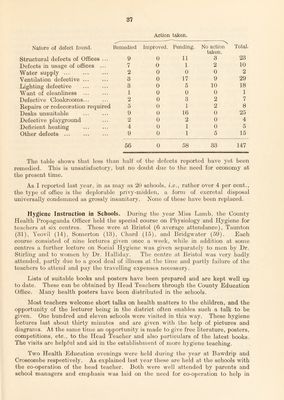
![A furtlier (> feebki-iuinded boys wcro accoimiiodated at tlic Western Counties Institution, Starcross, and two at ICitli Special Day School. Yatton Hall. This Institution is jiriinarily intended for low-grade defectives. At the end of U132 there were in residence 28 boys and 20 girls of school age in addition to older defectives. The acconnnodation is limited, and there is always a considerable waiting list for admission. Occupation Centres. Since 1920 the Somerset Association for Mental Welfare has provided very usefid Occuj)ation Centres in various parts of the County under the supervision of Miss Penrose. Last year the Centres at Taunton, Weston-super-Mare, Bridgwater, Street and Frome were continued. With the exception of Street the classes are now held on five days per week. All the children attending the Taunton and Bridgwater Centres belong to those Boroughs, but in December last there were on the Centre registers 28 children of school age (including three imbecile boys and one imbecile girl) belonging to the County. After Care of Mentally Defective Children. The Somerset Association for klental Welfare, through its officers and Voluntary Visitors, continues its valuable work of following up and assisting defective children who have left school. Those leaving Special Schools are notified to the Mental Deficiency Acts Committee for supervision, guardianship or further institutional care as may be necessary. During the year seven boys and eight gi)'ls were thus notified on reaching the age of sixteen. With the excej)tion of one boy at the Starcross Institution, all of these were detained at Sandhill Park. SCHOOL HYGIENE. Sanitary Condition of Schools. The importance of schools being in a sanitary and healthy condition is twofold. Defects such as faulty lighting, inadequate ventilation, or insufficient washing facilities may be directly ])rejudicial to the liealth of the children, while also schcn^ls are the centres for education and not the least important are the lessons imperceptibly taught to the children by a sanitary environment. It is part of the duty of School Medical Inspectors to report upon the sanitary condition of school premises and 475 reports were received, as well as 17 ui)t>n Secondary Schools. In 334 cases no defects were found or at least adversely reported upon. In 56 the defects were of a minor character and not followed up. In the remaining 1U2 instances the reports were referred to the Education Dffice to deal with. These, with the results obtained as regards their remedy, are summarised in the following table. The number is considerably more than 102, as many schools showed more than one defect.](https://iiif.wellcomecollection.org/image/b30112266_0040.jp2/full/800%2C/0/default.jpg)