Lower Umpqua texts ; and, Notes on the Kusan dialects / by Leo J. Frachtenberg.
- Leo J. Frachtenberg
- Date:
- 1914
Licence: In copyright
Credit: Lower Umpqua texts ; and, Notes on the Kusan dialects / by Leo J. Frachtenberg. Source: Wellcome Collection.
155/172 (page 147)
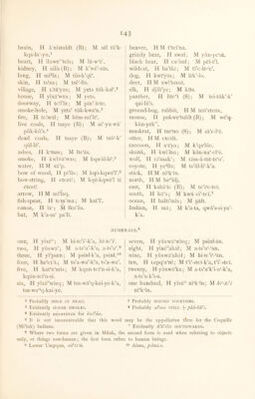
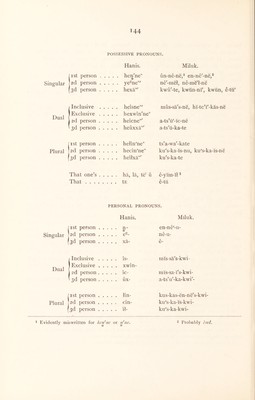
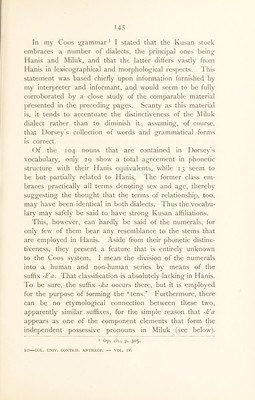
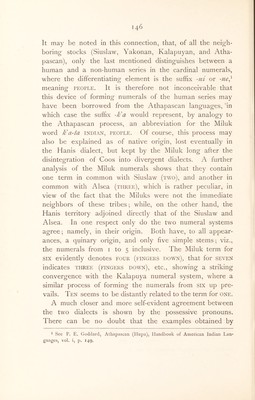
![Dorsey, especially the pronouns for the dual and plural, are auxiliary forms consisting' of at least two component elements, — one an initial element; and the other the sign of possession, which in ]\Iiluk would seem to be ne or te, in contrast to the Hanis tl. The possessive pronoun for the first person singular evidently consists of the per- sonal pronoun for that person (;/) plus the sign of pos- session ; or else it may be explained as having been miswritten for Jie7i7ie^\ in which case it would show perfect agreement with the Hanis form. The pronoun for the second person singular is quite distinct in form. The pronominal element conducing the idea of a second person singular would seem to be ne; the second com- ponent part is undoubtedly the Siuslaw case-ending -End; while the terminal ne is the previously-mentioned sign of possession, which may be omitted. The third person sin- gular consists of the demonstrative stems kwiL- or am- plified by means of the sign of possession. Dorsey was evidently unable to obtain a form for the exclusive dual. His two forms for the inclusive are easily correlated to the Hanis forms, but more properly should have been written nius-sa -Is-ne and hi-tci-Jc a-is-7ie. Mus-sd and ki- te i-da are probably synonymous terms for the numeral ONE (see above), and is-7ie is too self-evident to require further comment. The pronoun for the second person dual is composed of the numeral xa ts!u two, of the per- sonal pronoun is^ and of the possessive sign 7ie, The informant has in this case omitted the suffix -k'a, perhaps involuntarily. The form for the third person dual, literally translated, would mean of two people, and can by no means be regarded as a true possessive pronoun. In like manner the pronoun for the third person plural is no possessive form, for it simply means of all people [kus = Hanis gd^^s all; -k'a suffix expressing numerals of the](https://iiif.wellcomecollection.org/image/b28984821_0155.jp2/full/800%2C/0/default.jpg)