Report from the Select Committee on Aged Deserving Poor ; together with the proceedings of the Committee, minutes of evidence, and appendix.
- Great Britain. Royal Commission on the Aged Poor
- Date:
- 1899
Licence: Public Domain Mark
Credit: Report from the Select Committee on Aged Deserving Poor ; together with the proceedings of the Committee, minutes of evidence, and appendix. Source: Wellcome Collection.
Provider: This material has been provided by London School of Hygiene & Tropical Medicine Library & Archives Service. The original may be consulted at London School of Hygiene & Tropical Medicine Library & Archives Service.
52/466 page 2
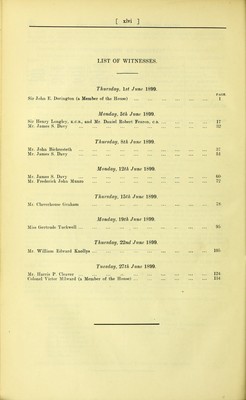
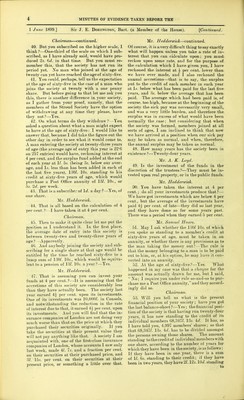
![1 June 1899.] Sir J. E. Dorington, Bart, (a Member of the House). [Contmued. Chairman—continued. of the larger societies ?—Yes; they arei the only foundation which exists in England for calcula- tion for this purpose, and I think the country is very much indebted to the Oddfellows and the Eoresters for the pains they have taken in elai- borating the tables of sickness and death. 6. But in his tables, as I understand, there was included a new principle?—Yes. 7. Which gave members an old age pension as well as payment during sickness, and pay- ment at death ?—Yes, but he got the materials on which to base the tables of the results which would be obtained from the actuarial calcula- tions which had been made by the Oddfellows' and the Foresters' Societies. The prospectus said that in ten years a member would probably have 12/. lis. dd., the calculation being based on 5 per cent, interest and an estimated amount of sickness ; but such member now has 15/. 18s. lOd. at the end of ten years. 8. You mean to say that, as compared with the estimate which was originally made of 121. lis. bd., such a member has got 15/. 18s. lOd. at the end of the ten years ?—Yes, as compared with 121. lis. 5d., which was the estimate. 9. They under estimated the results ?—They under estimated the results. I wanted toi point out that this scheme was not laid out on too san- guine an estimate of what was going to happen. 10. To make it clear, when the prospectus was issued it was held out that in the course of ten years, under this new principle, a person sub- scribing would have an interest in the concern amounting to 12/. lis. dd., whereas instead of that it has proved to be 15/. 18s. lOd. ?—Exactly. In twenty years he was estimated to have 30/. Os. 9d., and he has 45/. 2s. 6^^., and I, being the second member to join, and having placed myself on the highest scale of benefit allowed, namely, for sick pay of 30s. per week, did realise in the twenty-three years before; I reached the superannuation age of sixty-five the sum of 179/. 17s. lOd., which invested by the society for me in the purchase of a Post Ofiice annuity, as contemplated by their rules, produces a weekly pension of 7s. dd. An ordinary member sub- scribing for sick benefit of 10s. at the same age would have had 59/. 19s. dd., being one-third of what I have, and a. weekly allowance of very nearly 2s. 6d. ^ Mr. Hedderwich. 11. At what age were you superannuated ?— At sixty-five. 12. At that age it produced a weekly pension of 7s. bd. ?—-Yes; as a matter of fact, I may say this by way of correction, that I was super- annuated at sixty-five, but owing to the exact position in which my birthday fell with regard to the end of the benefi/t society's year, my annuity is based on the age of sixty-six. 13. That amount produces 7s. bd. ?—^Yes. I being sixty-six years of age got an annuity of 7s. bd.—^that is the real position. The society superannuated me at the close of their financial year in which I became sixty-five, but the annuity was not purchased till I was sixty-six. 14. At what age did you become a subscriber? —Twenty-three years previously. Chairman. lb. You said you had subscribed upon the highest scale—would you tell us with regard to the subscriptions to thei society?—I have here a comparative statement of contributions, and perhaps that would be the most convenient way of stating it. 16. I think probably it would. Will you give us that?—I have got a comparative table of con- tributions for sick pay of 10s. for six months, and 5s. afterwards, and 10/. at death, in the Odd- fellows and in the Stroud Society, and not less than 10/. in the Stroud Benefit Society, and such sum beyond 10/. as belongs to the member. The Oddfellows at twenty years of age pay Is. bd. per- month, and in the Stroud Society they pay 2s.^d. Sir James Rankin. 17. That is the case of a. young man joining at twenty years of age?—Yes, but the payment, will vary according to the age as he goes on, as you will hear directly. At thirty years of age an Oddfellow pays Is. 10<^., and at Stroud they pay 2s. 4<i. per month, but the Stroud Society does not vary its payment as between twenty and thirty; as a matter of fact the rates of sickness are so extremely similar between those ages that it was not thought worth while to' vary the rate of payment. After thirty the rate of payment varies. At forty years of age the Oddfellows pay 2s. %d., and at Stroud they pay 2s. %d. At forty- four an Oddfellow pays 2s. lid., and at Stroud »■ man pays 2s. lQ\d. There are no tables for tht Oddfellows (at least not in the copy I have of their rules) for ages over forty-four, but at Stroud a maji at fifty pays 3s. 2d. and at sixty he pays 3s. Id. Chairman. 18. Then according to the figures you have given us, the subscriptions to the Stroud Society are somewhat higher at all the different ages than the subscriptions to the Oddfellows ?—You will see that Oddfellows at the age of forty-four pay 2s. lid., and the Stroud members pay 2s. l^\d. We happen to be a little bit lower there; but after that age the Oddfellows do not seem to make any difference; perhaps they will not take any member after that. I do not know how that is. 19. But, generally speaking, the subscriptions to the Stroud Society are higher than the sub- scriptions to the Oddfellows, with the exception of that one year?—A little higher. I have not. given every year—I thought it would be trouble- some. Mr. Hedderwich. 20. I understand this Stroud Society has an additional benefit as compared with the Odd- fellows, namely, as regards old age ?—Yes. I said I subscribed on the highest scale, and I was asked what I paid. I have always paid three- times the amounts I have mentioned. Members of this society can subscribe for either a qua,rteir share or a half share, or three-quarters of a share, or a whole share (the whole share is what I have been mentioning), or for two shares or for three shares. The benefit of the lowest class is 2s. Q,d. a week sick pay, and of the highest class. 30s. 21. I understand](https://iiif.wellcomecollection.org/image/b24399516_0052.jp2/full/800%2C/0/default.jpg)



 No text description is available for this image
 No text description is available for this image
 No text description is available for this image