Report from the Select Committee on Aged Deserving Poor ; together with the proceedings of the Committee, minutes of evidence, and appendix.
- Great Britain. Royal Commission on the Aged Poor
- Date:
- 1899
Licence: Public Domain Mark
Credit: Report from the Select Committee on Aged Deserving Poor ; together with the proceedings of the Committee, minutes of evidence, and appendix. Source: Wellcome Collection.
Provider: This material has been provided by London School of Hygiene & Tropical Medicine Library & Archives Service. The original may be consulted at London School of Hygiene & Tropical Medicine Library & Archives Service.
95/466 page 45
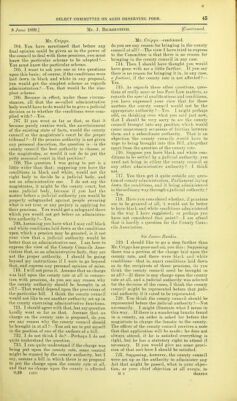
![8 Jime 1899.] Mr. J. Bickersteth. {Continued. Mr. Cripjys. 704. You have mentioned that brfore any final opinion oould be given as to the power of the council to deal with these pensions, you must know the particular scheme to be adopted Y— You must know the particular scheme. 705. I want to ask you one or two questions upon this basis ; of course, if the conditions were laid down in black and white in any proposal, you would get the simplest scheme as regards administration?—Yes, that would be the sim- plest scheme. 706. Because in effect, under those circum- stances, all thait ihe so-called administrative body would have to do would be to give a judicial decision as to whether the conditions were com- plied with ?—Yes. 707. If you went as far as that, so that it became purely routine work, the ascertainment of the existing state of facts, woiild the county council or the magistrate's court be the proper tribunal ?—If the pension authority is not given any personal discretion, the question is—is the county council the best authority to choose, or the magistraltes, or would it not do to put the petty sessional coiirt in that position ? 708. The question I was going to put is a little wider than that; supposing you have the conditions in black and white, would not the right body to decide be a judicial body, and not an administrative one. I do not say the magistrates, it might be the county court, but some judicial body, because if you had the matter before a judicial authority you would be properly safeguarded against people swearing what is not true, or any perjury in applying for their pensions. You woiild get a safeguard there which you would not get before an administra- tive authority ?—Yes. 709. Assuming you. have what I may call black and white conditions laid down as the conditions upon which a pension may be granted, is it not your view that a jiidicial authority would be better than an administrative one. I am here to express the view of the County Councils Asso- ciation that, as an administrative body, they are not the proper authority. I should be going beyond my instructions if I were to go beyond that, and express any personal opinion of mine. 710. I will not press it. Assume that no charge was laid upon the county rate at all in connec- tion with pensions, do you see any reason why the county authority should be brought in at all ?—That would depend upon the provisions of the particular bill. I think the county council would not like to see another authority set up in tlie county exercising administrative functions. 711. I should agree with that, but my question hardly went so far as that. Assume that no charge on the county rate is proposed, do you see any reason why the county council should be brought in at all ?—You ask me to put myself in the position of one of the authors of a bill. 712. I do not think I do ?—Perhaps I do not quite understand the question. 713. I can quite understand if the charge was being put upon the county rate, some control might be wanted by the county authority, but I say, assume a bill in which there is no proposal to put the charge upon the county rate at all, and that no cliarge upon the county is affected 0.29 i,-,30l Mr. Cripps—continued, do you see any reason for bringing in the county council at all ?—The view I have tried to express to the Committee is that there is no reason for bringing in the county council in any case. 714. Then I should have thought you wo\ild have gone with mc a little further. If you say there is no reason for bringing it in, in any case, a fortiori, if the county rate is not affected?— Yes. 715. As regards these other questions, ques- tions of really more or less Poor Law matters, as regards the specal qualifications and conditions, you have expressed your view that for those matters the county council would not be the appropriate authority?—Yes. I might perhaps add, on thinking over what you said just now, that I should be very sorry to see the county council brought into any position which would cause unnecessary occasions of friction between them and a subordinate authority. That is an objection the county councils iwould have to urge to being brought into this Bill, altogether apart from the question of the county rate. 710. vSuppose you have black and white con- ditions to be settled by a judicial authority, you need not bring in either the county council or any other administrative authority ?—I think not. 717. You then get it quite outside any ques- tion of county administration. Parliament laying down the conditions, and it being administered in the ordinary way through a judicial authority ? —Yes. 718. Have you considered whether, if pensions are to be granted at all, it would not be better to have black and white conditions administered in the way I have suggested; or perhaps you have not considered that point?—I am afraid that is hardly a question for the County Coun- cils Association. Sir James Rankin. 719. I should like to g'o a step further than Mr. Cripps has gone and ask you this : Su.pposing there was a portion of the charge laid upon the county rate, and there were black and white conditions—that is, exact conditions laid down as to the recipients of these pensions, do you think the county council need be brought in at all ?—If there is any charge upon the county rate at all, and a judicial authority was selected for the decision of the cases, I think the county council might be represented before that judi- cial authority if it cared to be represented. 720. You think the county council should be represented before the judicial authority ?—Not necessarily. I might illustrate what I mean in this way. If there is a wandering lunatic found in a county, an order is asked for before the magistrate to charge the lunatic to the county. The officer of the county council receives a note that that application will be made; he does not always attend, if he is satisfied everything is right, but he has a statutoiy rio-ht to attend if necessary. If you would give me some provi- sion of that sort here I should be satisfied. 721. Supposing, however, the county council were set up as the authority to administer any Act that might be passed, what is your objec- tion, or your chief objection at all events, to M 2 district](https://iiif.wellcomecollection.org/image/b24399516_0095.jp2/full/800%2C/0/default.jpg)


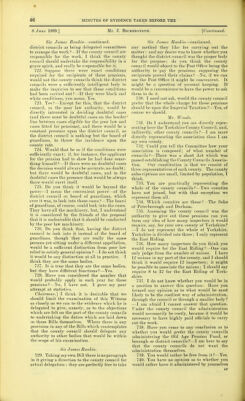
 No text description is available for this image
 No text description is available for this image
 No text description is available for this image