Man and woman : a study of human secondary sexual characters / by Havelock Ellis.
- Havelock Ellis
- Date:
- 1904
Licence: In copyright
Credit: Man and woman : a study of human secondary sexual characters / by Havelock Ellis. Source: Wellcome Collection.
Provider: This material has been provided by King’s College London. The original may be consulted at King’s College London.
65/538 page 41
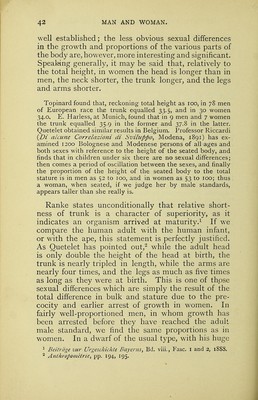
![view and refused to accept the statue as the ultimate model. Of course, said her creator; for that you would in fairness select a figure on the eighty or ninety per cent, line, not this, which meets exactly fifty per cent, of them all, and is half-way from the best to the worst; or, to put it more precisely, is only the greatest good of the greatest ?in?nber. He then naively explained her inferiority to the boy on a ground one hardly dare whisper —namely, that women students in colleges came from a class not equal, socially or intellectually, to that which universally sends its boys. [Whether this is the case or not it could scarcely account for the facts in question; the woman of low social class, at all events in the country, is favourably situated so far as the attainment of a well-developed and beautiful body is concerned.] The figure has more fragility without a corre- sponding gain in grace; the lower half is better than the upper; it is not that tight-lacing has left evident traces (the waist is over twenty-four), but the inward curve of the back, the thinness of the body, lack strength and erectness of pose. The height is five feet three, the weight one hundred and fourteen, the chest measurement but thirty, and the feet ten inches long. Differences in weight, although instructive as regards the individual's condition, are not of any great significance in the adult from our present point of view, and are in some respects fallacious. This is due to the tendency of women to develop exuberant fatty connective tissue. This tendency, while it is chiefly responsible for the charm and softness of the smoothly rounded feminine form, results in women possessing a larger amount than men of comparatively non-vital tissue and makes them appear larger than they really are. Bischoff once took the trouble to investigate the proportions of the various tissues in a man of thirty-three, a woman of twenty-two, and a boy of sixteen, who all died accidentally in good physical condition. He found the following relation between muscle and fat:— m. w. B. Muscle 41.8 ... 35.8 ... 44.2 Fat 18.2 ... 2S.2 ... 13.9 It is owing to this tendency to put on fat that, as Quetelet found, while man reaches his maximum weight at the age of forty, woman reaches hers only at fifty. The same tendency causes a liability to morbid obesity which all authorities agree to find more common in women; thus, for instance, of Bouchard's eighty-six cases, sixty-two were in women, and only twenty-four in men. The preponderance of the adult man over the adult woman in total stature and bulk is fairly obvious and](https://iiif.wellcomecollection.org/image/b21295190_0065.jp2/full/800%2C/0/default.jpg)