The plagiarisms of Julius Jeffreys, F.R.S., in his treatise on the statics of the human chest / by G. Calvert Holland.
- Date:
- 1844
Licence: Public Domain Mark
Credit: The plagiarisms of Julius Jeffreys, F.R.S., in his treatise on the statics of the human chest / by G. Calvert Holland. Source: Wellcome Collection.
Provider: This material has been provided by the Royal College of Physicians of Edinburgh. The original may be consulted at the Royal College of Physicians of Edinburgh.
21/36 page 21
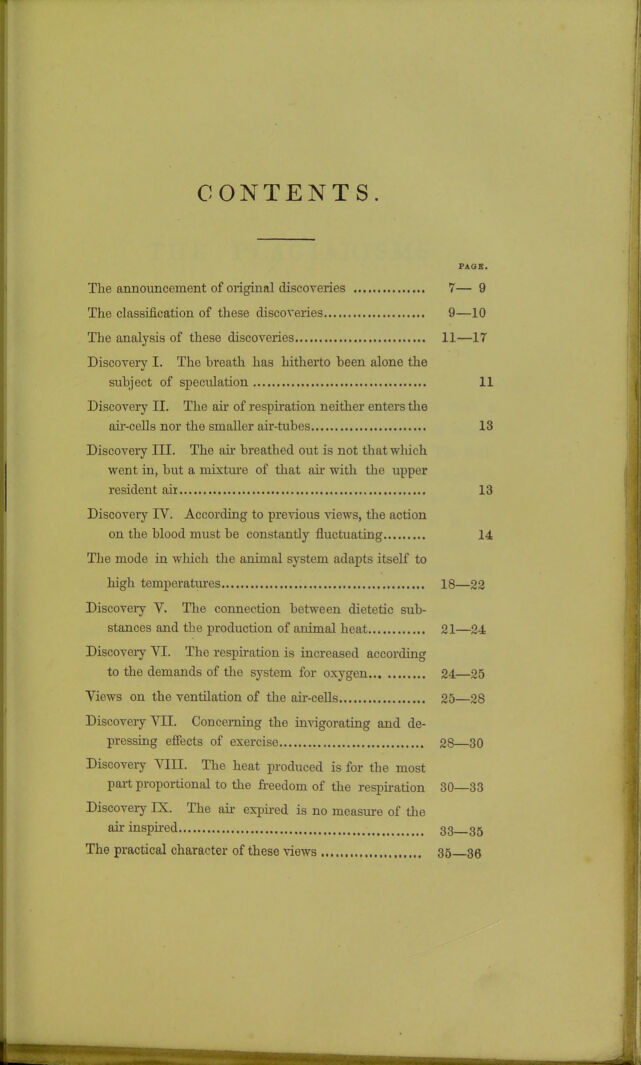
![still farther. So we observe that two causes are in operation, both of which will diminish the usual proportion of air acting on the blood; and, moreover, this diminution will he in the direct ratio to the increase of temperature, retarding its influence, not hy the gene- ration of cold, hut hy setting limits to the generation of heat.* “CCIX. There is a great difference between the powers that relieve the system from the effects of heat and those that circumscribe its evolution. The former are simply the extension of the ordinary and obvious laws of the animal economy ; the latter are the result of a principle less evident, and exercised only on extraordinary occasions. The excessive heat of 240° or 260° would destroy the body, if tlie 200° increased the generation of heat in the ratio of its numerical progression ; but every degree, from the temperation of the body to 200°, modifies the production of heat by augmenting the rarefaction of the air within the chest,—thus successively diminishing the quantity of oxygen submitted to the influence of the blood. “ If, therefore, the air is ratified before it is inspired, and if its general bulk be subsequently materially lessened ; and if in con- junction with these two conditions, we consider, that the quantity of air in the lungs indispensable to maintain the powers of life is very much ratified by an extensive and constant generation of caloric, we are enabled to appreciate the boundaries which Nature has set to the generation of animal heat.”]; Discovery V, The Connexion between Dietetic Substances and the production of Animal Heat.— This interesting and important department of scientific re- search has of late years been ably cultivated by Liebig, and many practical results have been brought out. Mr. Julius Jeffreys states, that he had also arrived at the same and other closely related discoveries, and had committed them to writing, but the publication had unfortunately been deferred from time to time.|| ITe remarks on this subject.' “ Iu endeavouring to ascertain the natural provision for reducing so greatly the production of heat, I was led to contrast with this state of things that of the condition ol human beings in the polar * Experimental Inquiry, p. 170. f Page 187. ] Page 188. The passages in italics, as originally printed. || Vide Opus cit. p. 197.](https://iiif.wellcomecollection.org/image/b21961839_0023.jp2/full/800%2C/0/default.jpg)