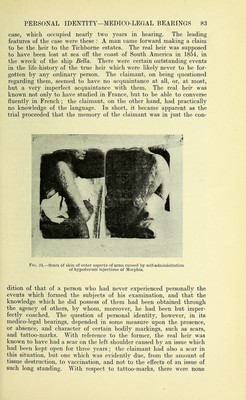
A text-book of medical jurisprudence and toxicology / by John Glaister.
- John Glaister
- Date:
- 1910
Licence: In copyright
Credit: A text-book of medical jurisprudence and toxicology / by John Glaister. Source: Wellcome Collection.
Provider: This material has been provided by The University of Glasgow Library. The original may be consulted at The University of Glasgow Library.
112/824 (page 86)
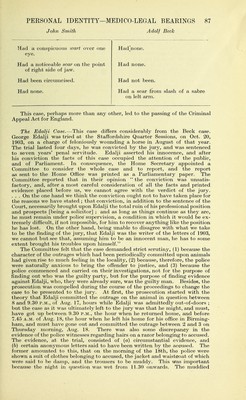
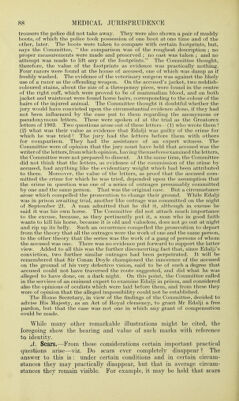
![have not spoken to one of these women before. They were set against me by the detectives. The woman who laid the charge against her deceiver gave a description of a man which moved this inspector of pohce to think of Beck. Along with the woman, the inspector went to the restam*ant where Beck took his food, and after observing Beck for a couple of hours the woman identified Beck as the man who had stolen her jewellery. The inspector thereupon arrested Beck. He was identified also by a second woman, who had been defrauded both in 1877 and in 1896, but her identification was based solely on the ground that the man who defrauded her had a grey moustache, as had also Beck. He was brought to trial, not before the judge who usually presided over the Court, because that judge was in 1896 counsel for the Crown in the prosecu- tion of Beck, and it was, therefore, deemed inadvisable that he should try this second charge, but before Mr Justice Grantham, on June 27, 1904. Four counsel were employed by the Treasury to prosecute the charge. The evidence led against him was practically identical with that in his trial in 1896 ; the female witnesses told the same story, and the handwriting expert swore that the handwriting of the letters, cheques, etc., given by the man who stole from the woman, was the same as that of the prisoner, but disguised. He was again found guilty, but Mr Justice Grantham postponed sentence. The proofs of the innocence of the accused, which had been pubhshed after his conviction in 1896, were sent to the judge by Beck's friends, to which, how- ever, the judge made the following reply:—I have already made special inquiries into this case, and have no doubt whatever of the correctness of the verdict, and cannot therefore direct or allow any other investigation to be made. Before Beck was brought up for sentence, however, what seemed to be a providential intervention on his behalf occurred. A chief inspector of the Metropolitan Detective Department in the course of his duty visited one of the police stations and inquired if there were any prisoners in the cells. He was told that there was a man in custody who had just been charged with having defrauded by a trick two women of their jewellery. This inspector had been present in Court when Beck was first convicted in 1896, and Beck's second conviction was then in his mind. He went into the cell. When he looked at the prisoner, he saw at once the scar on the point of the man's jaw which had not been found on Beck, and he involuntarily exclaimed John Smith ! He reported his discovery at once to his chiefs. Rapid investigation was thereupon made which corroborated the importance of the discovery, and next day Beck was informed of the facts. Two days later he was set free. On 29th July he received two pardons of the King foi convictions of crimes of which he was absolutely innocent. Such wrongous convictions of an innocent man, and the grave possibilities of mis-identification, seized the public mind, and questions were asked in Parliament concerning the case, and a vote of money as solatium to Beck. On 9th September a Committee of Inquiry into the circumstances of the con- victions was appointed by the Secretary of State for the Home Department. After hearing evidence in public, including that of Beck himself, the Committee reported on Nov. 14, 1904, that there is no shadow of foundation for any of the charges made against Mr Beck, or any reason for supposing that he had any connection whatever with them. The Committee also expressed their opinion that the miscarriage in this case could never have gone without remedy if the learned judge had seen fit to state a case for the consideration of the Coiu-t for Crown Cases Reserved on the point raised by Mr Gill [counsel for Beck]. We cannot doubt that if the matter could have been brought before that court, the flaw in the proceedings would have been judicially ascertained and the conviction quashed. The bodily markings which, if they had been properly recorded and com- pared, would have materially served to differentiate in the identification of these two men may^be^briefly summarised as follows ;—•](https://iiif.wellcomecollection.org/image/b21465605_0112.jp2/full/800%2C/0/default.jpg)