A text-book of medical jurisprudence and toxicology / by John Glaister.
- John Glaister
- Date:
- 1910
Licence: In copyright
Credit: A text-book of medical jurisprudence and toxicology / by John Glaister. Source: Wellcome Collection.
Provider: This material has been provided by The University of Glasgow Library. The original may be consulted at The University of Glasgow Library.
116/824 (page 90)
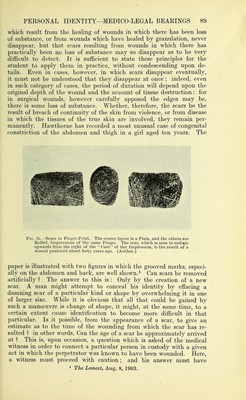
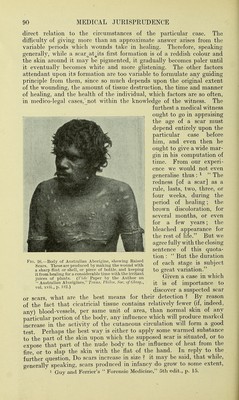
![direct relation to the circumstances of tlie particular case. The difficulty of giving more than an approximate answer arises from the variable periods which wounds take in healing. Therefore, speaking generally, while a scar^at^its first formation is of a reddish colour and the skin around it may be pigmented, it gradually becomes paler until it eventually becomes white and more glistening. The other factors attendant upon its formation are too variable to formulate any guiding principle from them, since so much depends upon the original extent of the wounding, the amount of tissue destruction, the time and manner of healing, and the health of the individual, which factors are so often, in medico-legal cases,^not within the knowledge of the witness. The furthest a medical witness ought to go in appraising the age of a scar must depend entirely upon the particular case before him, and even then he ought to give a wide mar- gin in his computation of time. From our experi- ence we would not even generalise thus : ^ The redness [of a scar] as a rule, lasts, two, three, or four weeks, during the period of healing; the brown discoloration, for several months, or even for a few years; the bleached appearance for the rest of life. But we agree fully with the closing sentence of this quota- tion : But the duration of each stage is subject to great variation. Given a case in which it is of importance to discover a suspected scar or scars, what are the best means for their detection % By reason of the fact that cicatricial tissue contains relatively fewer (if, indeed, any) blood-vessels, per same unit of area, than normal skin of any particular portion of the body, any influence which will produce marked increase in the activity of the cutaneous circulation will form a good test. Perhaps the best way is either to apply some warmed substance to the part of the skin upon which the supposed scar is situated, or to expose that part of the nude body to the influence of heat from the fire, or to slap the skin with the flat of the hand. In reply to the further question, Do scars increase in size ? it may be said, that while, generally speaking, scars produced in infancy do grow to some extent, 1 Guy and Ferrier's Forensic Medicine, 5th edit., p. 15. Fig. 26.—Body of Australian Aborigine, showing Raised Scars. These are produced by making the wound with a sharp flint or shell, or piece of bottle, and keeping it from healing for a considerable time with the irritant iuices of plants. {Vidr Paper by the Author on ' Australian Aborigines, Trans. PMlos. Soc. ofGlasg., vol. xvii., p. 1S2.)](https://iiif.wellcomecollection.org/image/b21465605_0116.jp2/full/800%2C/0/default.jpg)