A text-book of medical jurisprudence and toxicology / by John Glaister.
- John Glaister
- Date:
- 1910
Licence: In copyright
Credit: A text-book of medical jurisprudence and toxicology / by John Glaister. Source: Wellcome Collection.
Provider: This material has been provided by The University of Glasgow Library. The original may be consulted at The University of Glasgow Library.
223/824
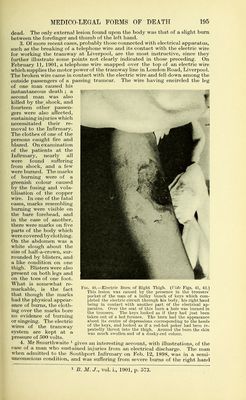
![dead. The only external lesion found upon the body was that of a slight burn between the forefinger and thumb of the left hand. 3. Of more recent cases, probably those connected with electrical apparatus, such as the breaking of a telephone wire and its contact with the electric wire for working the tramway at Liverpool, are the most instructive, since they further illustrate some points not clearly indicated in those preceding. On February 11, 1901, a telephone wire snapped over the top of an electric wire which supplies the motor power of the tramway line in London Road, Liverpool. The broken wire came in contact with the electric wire and fell down among the outside passengers of a passing tramcar. The wire having encircled the leg of one man caused his instantaneous death ; a second man was also killed by the] shock, and fourteen other passen- gers were also affected, sustaining injuries which necessitated their re- moval to the Infirmary. The clothes of one of the persons caught fire and blazed. On examination of the patients at the Infirmary, nearly all were found suffering from shock, and a few were burned. The marks of biu'ning were of a greenish colour caused by the fusing and vola- tilisation of the copper wire. In one of the fatal cases, marks resembling burning were visible on the bare forehead, and in the case of another, there were marks on five parts of the body which were covered by clothing. On the abdomen was a white slough about the size of half-a-crown, sur- rounded by blisters, and a like condition on one thigh i Blisters were also present on both legs and on the toes of one foot. What is somewhat re- markable, is the fact that though the marks had the physical appear- ance of burns, the cloth- ing over the marks bore no evidence of burning or singeing. The electric wires of the tramway system are kept at a pressure of 500 volts. 4. Mr Smurthwaite ^ gives an interesting accovmt, with illustrations, of the case of a man who sustained injuries from an electrical discharge. The man when admitted to the Southport Infirmary on Feb. 12, 1898, was in a semi- unconscious condition, and was suffering from severe burns of the right hand Fig. 40.—Electric Burn of Right Thigh. (Vide Figs. 41, 42.) This lesion was caused by the presence in the trousers' pocket of the man of a bulky bunch of keys which com- pleted the electric circuit through his body, his right hand Yjeing in contact with another part of the electrical ap- paratus. Over the seat of this burn a hole was burned in the trousers. The keys looked as if they had just been taken out of a hot furnace. The burn had the appearance about its centre of depressions corresponding to the heads of the keys, and looked as if a red-hot poker had been re- peatedly thrust into the thigh. Around the burn the skin was much swollen and of a dusky-red colour.](https://iiif.wellcomecollection.org/image/b21465605_0223.jp2/full/800%2C/0/default.jpg)