A text-book of medical jurisprudence and toxicology / by John Glaister.
- John Glaister
- Date:
- 1910
Licence: In copyright
Credit: A text-book of medical jurisprudence and toxicology / by John Glaister. Source: Wellcome Collection.
Provider: This material has been provided by The University of Glasgow Library. The original may be consulted at The University of Glasgow Library.
38/824 page 12
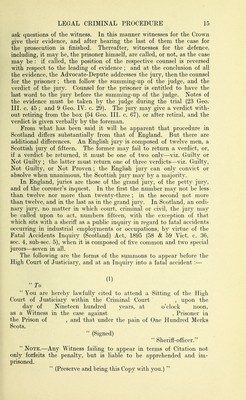
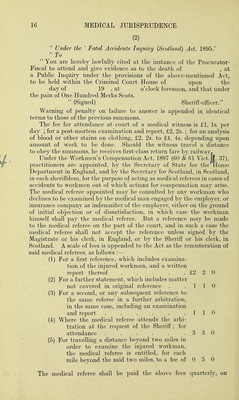
![same employer as the dead person, shall be a member. After hearing the evidence, of which part is almost certain to be medical, and after the summing-up of the Sheriff, the jury shall return a verdict which shall set forth when and where the accident and the death took place, and the cause or causes of the accident or death, and other facts as to fault or negligence of anyone or defects in mode of working in the case of accidents, if any. The verdict is usually unanimous, but it may be returned by a majority at anytime not less than one hour after it [the jury] has been enclosed. For this duty each juror is remunerated at the rate of 5s. for each day, or part of a day, and by travelling expenses. It is the duty of the Fiscal at the close of the inquiry to transmit all the documents, including reports or productions, with a copy of the verdict, together with the usual schedule for the registrar of deaths,^'' to the Crown Agent. His duties, therefore, include the sphere of action of the coroner in England. In carrying out the criminal part of his office, his instruc- tions are, when serious cases of crime are reported to him, to proceed to the locus with the Sheriff and make an examination for himself; in such cases as rape, child-murder, or concealment of pregnancy, where invaluable evidence of the commission of the crime may be lost by delay, he is expected to secure early medical examination of the assaulted person and of the accused ; where death results from violence, to see that a post-mortem examination is made by medical men of skill, who shall, as soon thereafter as possible, furnish him with a report of the said examination, and of their opinion as to the cause of the death ; in the event of a serious assault to the extent of danger to life, and where death after an interval takes place, he is expected to obtain accurate evidence respecting the treatment of the injured person during the said interval; and to be prepared when called upon, in the event of assaults of the above kind likely to prove mortal, to proceed with a magistrate and take the deposition of the dying person upon oath, which deposition should be signed when possible by the said person and the magistrate in attendance ; or he may instruct the medical attendants of the injured person how to proceed in this direction in the event of such a sudden change occurring in the condition of the person as would not permit of time for the legal authorities to be summoned. It may be said, too, that inquiry into the causes of sudden deaths is also prompted from the point of view of crime, since it is the suspicion of culpability which initiates his action. In such cases, in deaths from accident, and in all cases of sudden deaths reported to him by the police, or otherwise, he shall precognosce witnesses, among whom a medical witness shall be one, and from whom he shall have asked and received a proper medical report as to the cause of death, without a post-mortem examination where the cause of death can be ascer- tained without it, otherwise after a post-mortem examination. As a medical witness may require to appear in any of the criminal law-courts, the following indicates the names of these courts, and, to some extent, the class of cases which are tried therein :—■ I. Burgh Police Court: for trifling offences, or as the court of first instance, in remands to a higher court. II. Justices' Court, in Counties : for like offences.](https://iiif.wellcomecollection.org/image/b21465605_0038.jp2/full/800%2C/0/default.jpg)
 No text description is available for this image
 No text description is available for this image
 No text description is available for this image