Report of the Working Party on the Recruitment, Training and Qualification of Sanitary Inspectors.
- Great Britain. Working Party on the Recruitment, Training and Qualification of Sanitary Inspectors
- Date:
- 1953
Licence: Public Domain Mark
Credit: Report of the Working Party on the Recruitment, Training and Qualification of Sanitary Inspectors. Source: Wellcome Collection.
36/156 (page 28)
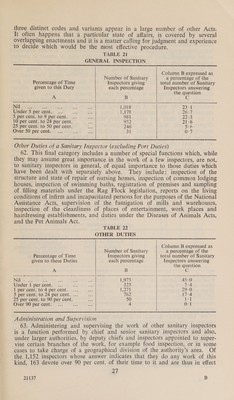
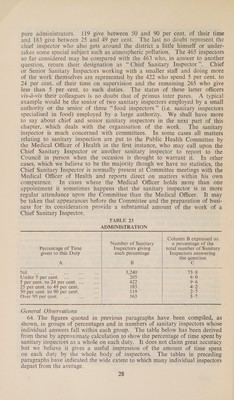
![pure administrators. 119 give between 50 and 90 per cent. of their time and 183 give between 25 and 49 per cent. ‘The last no doubt represent the chief inspector who also gets around the district a little himself or under- takes some special subject such as atmospheric pollution. The 465 inspectors so far considered may be compared with the 463 who, in answer to another question, return their designation as “Chief Sanitary Inspector”. Chief or Senior Sanitary Inspectors working with a smaller staff and doing more of the work themselves are represented by the 422 who spend 5 per cent. to 24 per cent. of their time on supervision and the remaining 265 who give less than 5 per cent. to such duties. The status of these latter officers vis-a-vis their colleagues is no doubt that of primus inter pares. <A typical example would be the senior of two sanitary inspectors employed by a small authority or the senior of three “food inspectors” (i.e. sanitary inspectors specialised in food) employed by a large authority. We shall have more to say about chief and senior sanitary inspectors in the next part of this chapter, which deals with the organisation of the work. The sanitary inspector is much concerned with committees. In some cases all matters relating to sanitary inspection are put to the Public Health Committee by the Medical Officer of Health in the first instance, who may call upon the Chief Sanitary Inspector or another sanitary inspector to report to the Council in person when the occasion is thought to warrant it. In other cases, which we believe to be the majority though we have no statistics, the Chief Sanitary Inspector is normally present at Committee meetings with the Medical Officer of Health and reports direct on matters within his own competence. In cases where the Medical Officer holds more than one appointment it sometimes happens that the sanitary inspector is in more regular attendance upon the Committee than the Medical Officer. It may be taken that appearances before the Committee and the preparation of busi- ness for its consideration provide a substantial amount of the work of a Chief Sanitary Inspector. TABLE 23 ADMINISTRATION Column B expressed as Number of Sanitary a percentage of the Percentage of Time Inspectors giving total number of Sanitary given to this Duty each percentage Inspectors answering the question A B ‘S it re “e pe aE Pi 3,240 WSS Under-S per cent. ~~ <.: a ae 265 6:0 5. per cent sto24 per cent. 2. ak 422 9-6 25 per cent. to 49 per cent. he 183 4-2 50 per cent. to 90 per cent. fe 119 Dey] Over S0 percent” *.. oe 7 163 3°7 General Observations 64. The figures quoted in previous paragraphs have been compiled, as shown, in groups of percentages and in numbers of sanitary inspectors whose individual answers fall within each group. The table below has been derived from these by approximate calculation to show the percentage of time spent by sanitary inspectors as a whole on each duty. It does not claim great accuracy but we believe it gives a useful impression of the amount of time spent on each duty by the whole body of inspectors. The tables in preceding paragraphs have indicated the wide extent to which many individual inspectors depart from the average.](https://iiif.wellcomecollection.org/image/b32177501_0036.jp2/full/800%2C/0/default.jpg)