Resolution of the alpha-beta-dihydroxy-alpha-methyl-beta-isopropyladipic acids / by T.A. Henry and H. Paget.
- Thomas Anderson Henry
- Date:
- [1923.]
Licence: Public Domain Mark
Credit: Resolution of the alpha-beta-dihydroxy-alpha-methyl-beta-isopropyladipic acids / by T.A. Henry and H. Paget. Source: Wellcome Collection.
3/16
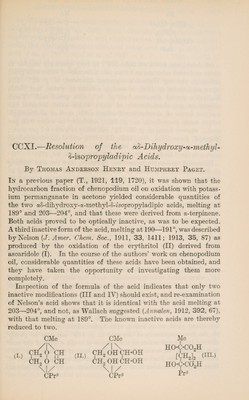
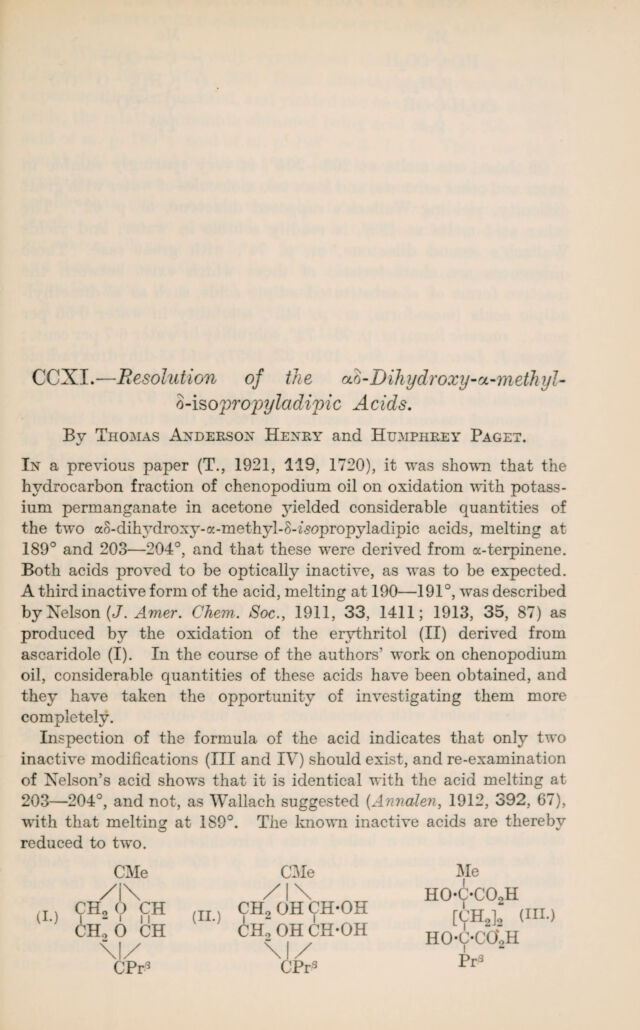
![CCXI.—Resolution of the oLO-JJihydroxy-oc-methyl- o-isopropyladipic Acids. By Thomas Anderson Henry and Humphrey Paget. In a previous paper (T., 1921, 119, 1720), it was shown that the hydrocarbon fraction of chenopodium oil on oxidation with potass¬ ium permanganate in acetone 3rielded considerable quantities of the two aS-dihydroxy-a-methyl-8-jsopropyladipic acids, melting at 189° and 203—204°, and that these were derived from a-terpinene. Both acids proved to be optically inactive, as was to be expected. A third inactive form of the acid, melting at 190—191°, was described by Nelson (J. Amer. Chem. Soc., 1911, 33, 1411; 1913, 35, 87) as produced by the oxidation of the erythritol (II) derived from ascaridole (I). In the course of the authors’ work on chenopodium oil, considerable quantities of these acids have been obtained, and they have taken the opportunity of investigating them more completely. Inspection of the formula of the acid indicates that only two inactive modifications (III and IV) should exist, and re-examination of Nelson’s acid shows that it is identical with the acid melting at 203—204°, and not, as Wallach suggested (Annalen, 1912, 392, 67), with that melting at 189°. The known inactive acids are thereby reduced to two. CMe /i\ do $h29 £H CH, O CH \l/ CPC CMe ,Tr. CH.OHCH-OH CH. OH CH-OH CPr3 Me HO-C-C02H [CH2]2 (HI-) HO’C-CO'.H I Pr3](https://iiif.wellcomecollection.org/image/b30624058_0003.jp2/full/800%2C/0/default.jpg)