Resolution of the alpha-beta-dihydroxy-alpha-methyl-beta-isopropyladipic acids / by T.A. Henry and H. Paget.
- Thomas Anderson Henry
- Date:
- [1923.]
Licence: Public Domain Mark
Credit: Resolution of the alpha-beta-dihydroxy-alpha-methyl-beta-isopropyladipic acids / by T.A. Henry and H. Paget. Source: Wellcome Collection.
4/16 page 1879
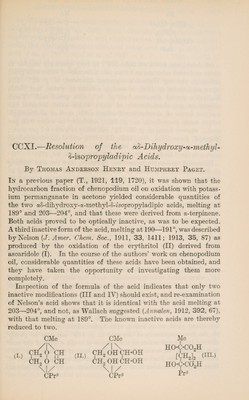
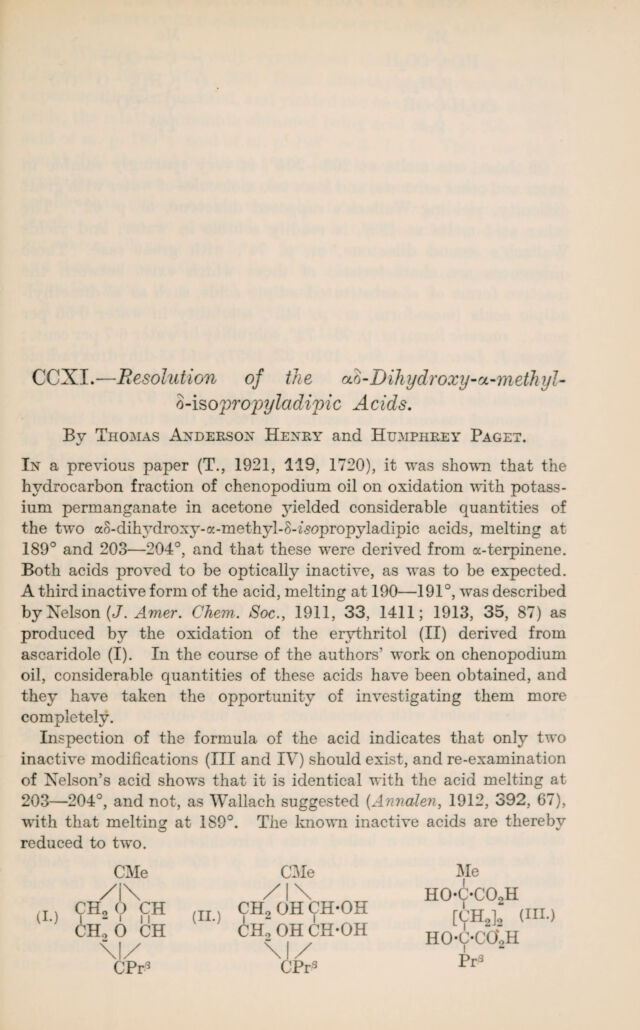
![Me ho-c-co2h av-) [CH2]2 co2h-c*oh Pr3 Me j—C—C0-| O [CEL]. O (V.) 1—C—COJ Pri3 Of these, one melts at 203—204°, is very sparingly soluble in water and other solvents, and loses two molecules of water with great difficulty, yielding Wallach’s supposed dilactone, m. p. 62°. The other acid melts at 189°, is readily soluble in water, and yields Wallach’s second dilactone, m. p. 74°, with great ease. These differences are characteristic of those which exist between the inactive forms of aS-substituted adipic acids, such as aS-dimethyl- adipic acids (meso-form, m. p. 142°, solubility in water 0*56 per cent.; racemic form, m. p. 70—72°, solubility in water 6-7 per cent.; Noyes, J. Amer. Chem. Soc., 1910, 32, 1057), and af-dihydroxyadipic acids (meso-form, m. p. 174°, less soluble; racemic form, m. p. 146°, more soluble; Le Sueur, T., 1908, 93, 716; 1910, 97, 173). It seemed reasonable to assume, therefore, that the acid melting at 203—204° corresponded to the meso-ioim and that melting at 189° to the racemic form of these analogous acids, and could be regarded respectively as anti- (III), and para- (IV) forms; terms which have been revived by Dakin to distinguish the two inactive forms of hydroxyaspartic acid, which are analogous with the acids now dealt with (J. Biol. Chem., 1921, 48, 273; 1922, 50, 403). The facts are, however, not quite so simple. The acid of higher m. p. does not, as Wallach stated, lose two molecules of water when boiled with hydrochloric acid and form the dilactone,” m. p. 62°. This change occurs only on dry distillation under reduced pressure. Further, the supposed “ dilactone ” is in reality the anhydride (V) of 1 : 4-cineolic acid, and yields the latter acid on hydration. The more fusible acid, on the contrary, readily yields a dilactone, m. p. 74°, when boiled with hydrochloric acid, but only to the extent of 50 per cent, of its weight, and the residual liquor left in the flask now contains the remaining 50 per cent, in the form of the acid melting at 203—204°. Further, this dilactone on hydration yields a new acid, m. p. 198°, intermediate in solubility between the two already described, which reproduces the dilactone, m. p. 74°, in the calculated yield when boiled with hjffirochloric acid. Separation of the two components of the acid m. p. 189° can also be partly effected by crystallisation of the quinine salt, the dbform of the acid m.p. 203—204° separating first and the d-form of the acid m. p. 198° remaining in the final mother-liquors, but the optical antipodes of these camiot be isolated from the middle fractions by crystallisation.](https://iiif.wellcomecollection.org/image/b30624058_0004.jp2/full/800%2C/0/default.jpg)