Volume 1
Minutes of evidence taken before the Royal Commission on the War in South Africa.
- Great Britain. Royal Commission on the South African War, 1899-1900
- Date:
- 1903
Licence: Public Domain Mark
Credit: Minutes of evidence taken before the Royal Commission on the War in South Africa. Source: Wellcome Collection.
92/558 page 74
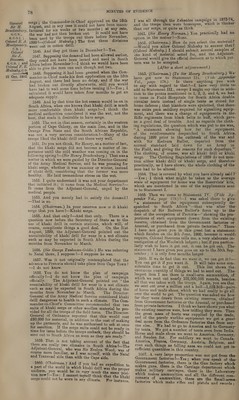
![General going out with ammunition, including all the Imperial Siero. Yeomanry who were raised. We had to send out Brackenbury, ammunition for all the colonial troops who went. G.C.B., 1602. (Chairman.) In addition to the 5,000,000 a K.CS.1.5 week ?—No, but that 5,000,000 a week went on and on Colonel R. A. till June, I think ; we sent out altogether 102,000,000, Montgomery, besides all that went out with the troops. There was aay one great difficulty we had with regard to the supply sear mg of small-arm ammunitica, which, perhaps, Thadebetier Steevens, mention here. Owing to the experience of the Chitral K.C.B. ; and campaign, it was considered desirable that we should Colonel F. E. have a more deadly bullet than the ordinary Mark II. Muleahy,c.B. ammunition, which was im use with the -303-inch Aton — calibre magazine rifle. The Mark II. ammunition Oct. 1902. bullet is, as you know, a very small bullet, less than - one-third of an inch in diameter, including the cupro- nickel envelope with which it is covered, and it was found from the experience of the Chitral campaign that it had not what was called sufficient stopping power against the rush of Ghazis, and, accordingly, in this country, as well as in India, an effort was made to find a satisfactory bullet which would have’a more deadly effect. In India they produced the Dum-dum ammuni- tiou, in which the head of the bullet is not covered by the nickel envelope. In this country we pro- duced a bullet in which there is a small cylindrical hole in the lead at the top, and this is left as an open- ing, and is not covered over with the nickel. This bullet was an expanding bullet. We had every inten- tion of using this bullet and making it, in fact, the bullet for the British Army all over the world, and, 1 think, about 66,000,000 of it up to the 31st March, 1899, had been delivered, and formed part of our stock of 172,000,000. It was known as Mark IV. We had an exceptionally hot summer in 1899, and it was found that, especially in the hands of Volunteers, where the rifles had not been kept par- ticularly clean, there were several instances in which this bullet stripped, to use the technical term; that is to say, the lead of the bullet squirted out through this opening in the top of the nickel envelope, and left the envelope behind in the rifle. Then, if there was a second load, you were apt to get an accident, a blow back in the breech. This happened at Bisley, and it happened in several other places with Volunteers. There could be very little doubt of what was the cause of it; it was due to exceptional heat, and it required a rifle which was not clean. We carried out a great number of experiments to try to reproduce this, and we always found it most difficult to reproduce, and the only conditions under which we could reproduce it were the conditions of great heat and a dirty rifle. Those two conditions of great heat and a dirty rifle were exactly the conditions which were likely to occur in war, and, therefore, it seemed to me, and I so ad- vised the Commander-in-Chief and the Secretary of State, that none of this ammunition should be con- sidered serviceable for war, and, consequently, ‘66,000,000, or thereabouts, of our reserve was non-effec- tive for purposes of war. It was about the same time also in that summer that the Hague Convention sat, and passed a resolution against all expanding bullets, but our Government was not a party to that Convention, and they declined to be bound by it; but, nevertheless, it is impossible to avoid a feeling that it had a certain moral effect, and that it was not considered desirable to use an expanding bullet in time of war. The reason why we did not use the expanding bullet in South Africa was not the Hague Convention, however, but. be- cause the Mark IV. ammunition, our expanding am- munition, had proved unfit to be used in war. Con- sequently, about two-fifths of our reserve. of ammuni- tion could not be used. We were driven to great straits at one time, because we had actually got reduced in this country to two or three boxes of Mark II. ammuni- tion, so that if we had had to go to war with a Euro- pean Power we should have had to fight them with expanding bullets. Then, as regards hospital equip- ment, we had no reserve, and we had only material for one general and two stationary hospitals in our mobilisation equipment, and by the 15th December we had sent out five general hospitals, and were asked for a sixth, and J have stated here, in Statement IV. (Vide Appendix Vol., page 187,) that before the 30th September, 1899, we equipped and shipped from Wool- wich five stationary hospitals and 16 general hospitals, each of 520 beds. That shows how inadequate our re- serves were. 1603. The same was the case with the genera] stores 2 —Yes, our reserve of general stores was utterly inade- quate to meet the demands; we had to buy on the. market whatever we could get. As an example, we had an authorised reserve of 52,000 sets of horse shoes, but no mule shoes, and I had before December to send 35,000 sets of horse shoes and 40,000 sets of mule shoes to Africa monthly to keep the animals shod. Later on, this grew to about 100,000 sets of horse shoes and 70,000 mule shoes. 1604. Monthly?—Monthly, and we had to go to Germany and Sweden for horse shoes, and to the United States for mule shoes. Nobody in this country at first seemed to be able to make mule shoes. Our re- serves of clothimg were inadequate to meet even peace requirements, and before the war broke out I had asked for a reserve to be prepared equal to six months’ ordinary supplies, which would cost £520,000, and that demand had received no answer. It had been put for- ward, I think, by us in February, 1899, just after I took office, and it remained in the Accountant-General’s Department, not minuted upon, until after the Mowatt Committee had assembled, and’ it then saw daylight again. 1605. How long was that ?—From February, 1899, till January, 1900. Then I should like to say that the responsibility for the supply of clothing had only been transferred to the Director-General of Ordnance shortly before the beginning of 1899. I think it was on the 1st of December, 1898, that Colonel Mulcahy, a first class Ordnance officer, took over the charge of the Clothing Department, and at that time the Estimates for the year 1899-1900 had beem already prepared, so that my department was not responsible for the Esti- mates; but Mr. De la Bere, who had been Assistant Director of Clothing under the old system, in sending in the final estimates, had stated that the amount. of money would be insufficient for ordinary peace re- quirements. 1606. (Viscount Esher.) That was in the preparation of the Estimates for what year?—From 1st April, 1899, to 3lst March, 1900. 1607. (Chairman.) Was that statement of Mr. De la Bere sent on in any way ?—Yes, that accompanied the estimates to the Accountant-General. 1608. When a representation of that kind is left dor- mant, do you not take any further steps?—You mean as regards the £320,000 for clothing? 1609. Yes?—I did take steps; I called attention to it more than once, but I think, the war then coming upon us, everybody’s mind was taken up with bigger things than providing this peace reserve; the whole question grew so very much bigger. . 1610. The delay was owing to the special circum- stances?—Yes. In ordinary circumstances, if a repre-. sentation of ours in regard to money requirements is. not dealt with at once we should try to hasten the reply, and I should press it personally. 1611. And, probably, you would get an answer ?— Yes. Again, special difficulties arose in regard to cloth- ing, and in order to clothe the Army the whole trade of the country was occupied by us and for us, and the clothing factory at Pimlico was working to its full power and a great deal of overtime. We could not get sufficient helmets, and we had to borrow them from India. We could not even get sufficient boots, and we had to borrow boots from India. 1612. (Sir George Taubman-Goldie.) This is 1899 you are still speaking of ?—Yes. 1613. Not after the 15th December, but during the first portion of the war?—Yes; but we could not, at first, send out sufficient reserves to meet proper wear and tear, and we could not get the stuff. Then, as regards the Ordnance factories, in order to meet the demands of the Army in South Africa, in the labora- tory and in the carriage department all Naval orders had to be put aside from the beginning of October, and the whole of the departments manufacturing material were employed up to their fullest capacity. The Ordnance factories were working day and night and Sundays, and yet we were only just able to keep pace with demands. A great deal of the machinery in the Ordnance factories urgently needed replacement by labour-saving machines, and we had no real reserve of power of output in the country ; and it caused me the ~ deepest anxiety as to what would take place in the event of a war in which both Navy and Army were engaged, for if in this war, in which only the land forces were engaged, we had, in order to keep up sup~](https://iiif.wellcomecollection.org/image/b32177367_0001_0092.jp2/full/800%2C/0/default.jpg)

 No text description is available for this image
 No text description is available for this image
 No text description is available for this image