Autoplastic ovarian transplantation and its clinical significance / by J.H. Nattrass.
- Nattrass, John Hodgson.
- Date:
- 1910
Licence: In copyright
Credit: Autoplastic ovarian transplantation and its clinical significance / by J.H. Nattrass. Source: Wellcome Collection.
Provider: This material has been provided by The Royal College of Surgeons of England. The original may be consulted at The Royal College of Surgeons of England.
13/33 (page 9)
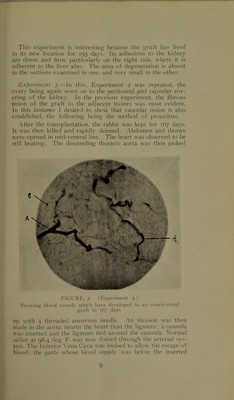
![Tliis experiment is interestinj^' because the c^raft has lived in its new location for 195 days, its adhesions to the kidney are dense and rtrin, particularly on the rii^’ht side, where it is adherent to the liver also. The area of dej^eneration is absent in the .sections examined in one, and very small in the other. ISxf'criinciit j.—In this, Exjjeriment 2 was rejieated, the ovary being again sewn on to the peritoneal and capsular cov- ering of the kidney. In the previous experiment, the fibrous union of the graft to the adjacent tissues was most evident. In this instaiK'e I desire<l to show that vascular union is also established, the following being the method of pnjcedure. .\fter the transplantation, the rabbit was kejjt for 167 days. It was then killed and rajndly skinned. Abdomen and thorax were opened in mid-ventral line. The heart was observed to be still beating. The descending thoracic aorta was then ])icked I-'lCiL’KI-'. 3- f Experiment 3.) Sinewing vessels wliich liave clevelo])ed in an ovario-rcnal graft in idj days. U]j with a threaded aneurism needle. An incision was then made in the aorta, nearer the heart than the ligature: a cannula was inserted and the ligature tied around the cannula. Xormal saline at 9S.4 deg. h\ was now forced through the arterial sys- tem. The Inferior \'ena Cava was incised to allow the escape of blood; the jtarts whetse blood su])ply was below the inserterl](https://iiif.wellcomecollection.org/image/b22428884_0013.jp2/full/800%2C/0/default.jpg)