Autoplastic ovarian transplantation and its clinical significance / by J.H. Nattrass.
- Nattrass, John Hodgson.
- Date:
- 1910
Licence: In copyright
Credit: Autoplastic ovarian transplantation and its clinical significance / by J.H. Nattrass. Source: Wellcome Collection.
Provider: This material has been provided by The Royal College of Surgeons of England. The original may be consulted at The Royal College of Surgeons of England.
21/33 (page 17)
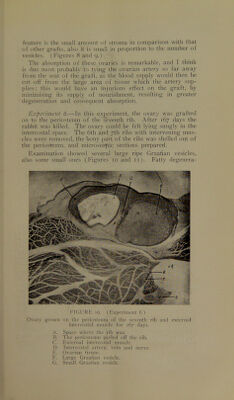
![On examiniii!;' the orii^inal ovarian sites, it was discovered, that when tyin^' the left ovarian artery at the time of the oper- ation. a small piece of the ovary had become in.volved in the knot of the ligature, and this had bec(,)me hypertro]diied until it was about one quarter the size of a pea. and this had un- doubtedly g’iven rise to the ovum which had ])roduced the foetation. B.vpcriiiiciit 8.—In this experiment the right and left ovaries were excised and were transplanted on to the peritoneum lining the anterior abdominal wall. 173 days after the graft- ing the animal gave birth to two young ones, then 26 days later to another family of four, premature ones. The rabbit was subse((uently killed and examined. Both the grafts had become absorbed, all trace of them had completely disap- peared, e.xcept for some remains of the silk ligatures; as in Experiment 7 a small ])iece of ovary was found involved in the knot tying the ovarian artery on each side. These two e.xperiments are e.xceedingly interesting, as they are the only ones in this auto])lastic grou]:). where complete ab.sor])tion of the graft has occurred. As they are the only ones in which the oophorectomy was incom])lete. the question immediately suggests it.self, as to whether the remnant was the cause of the absor])tion of the grafts or not. Crowe, Cushing and Homans. working at transplant- ations of the ])ituitary body, found that, in order to get the best transjdantation results, that gland had first to be com- pletely e.xcised from its normal position; if this were not done, their trans])lantations were more or less unsuccessful. These observations made by them regarding the pituitary trans]3lantations. concur exactly with these results, obtained bv me in ovarian transplantations. In all my experiments, withou); exception, where the ovaries were comiDletely removed from their normal position, and transplanted elsewhere in the body, the grafting was accomplished so successfully that func- tional ovaries resulted, but in each case, i.c.. Experiments 7 and 8, where the excision was incomplete, absorption of the grafts occurred. It would appear from a consideration of these results that complete e.xcision of a gland, yielding an internal secretion, creates in the body a ])hysiol(ygical want, and then even a grafted gland is welcomed by the organism as a factor having- power to su])])ly the want; but if the e.xcision were incom])lete, the remnant has the i)ower to su])ply the needs of the bodv, and then any graft being superfluous, the ])rotective agencies regard it as a foreign substance and remove it.](https://iiif.wellcomecollection.org/image/b22428884_0021.jp2/full/800%2C/0/default.jpg)