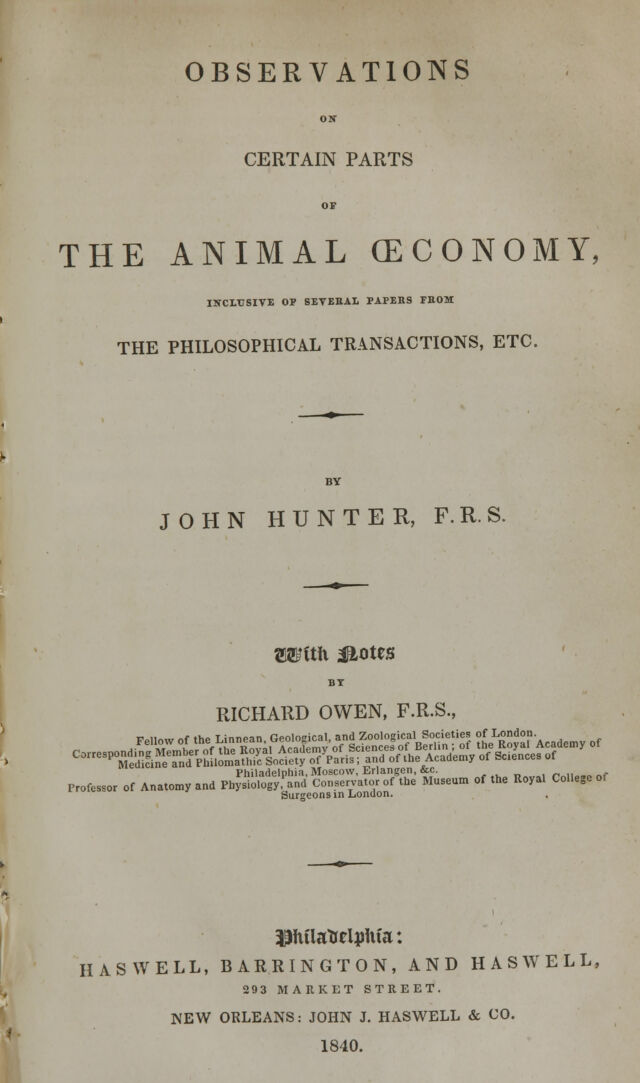
Observations on certain parts of the animal oeconomy : inclusive of several papers from the Philosophical transactions, etc. / by John Hunter ... ; with notes by Richard Owen.
- John Hunter
- Date:
- 1840
Licence: Public Domain Mark
Credit: Observations on certain parts of the animal oeconomy : inclusive of several papers from the Philosophical transactions, etc. / by John Hunter ... ; with notes by Richard Owen. Source: Wellcome Collection.
Provider: This material has been provided by the National Library of Medicine (U.S.), through the Medical Heritage Library. The original may be consulted at the National Library of Medicine (U.S.)
11/484
![the side of the testis; and its greatest part is made up of one con- voluted canal, which becomes larger in size and less convoluted towards the lower end, and at last is manifestly a single tube run- ning a little serpentine. That change happens at the lower end of the testis, and there the canal takes the name of vas deferens. The vas deferens is a little convoluted or serpentine in its whole course, but is less so as it comes nearer to the bladder; instead of running upwards from the lower end of the testis, as it does when the testicle is in the scrotum, while that remains in the abdomen, it runs downwards and inwards in its whole course, so that it goes on almost in the direction of the epididymis, of which it is a continua- tion. It turns inwards from the lower end of the epididymis, under the lower end of the testis, and behind the upper end of a ligament or gubernaculum testis (which I shall presently describe); then it passes over the iliac vessels, and over the inside of the psoas muscle, somewhat higher than in adult bodies, and at last goes between the ureter and bladder towards the basis of the prostate gland. p. 77. In those animals where the testicles change their situation the ere- master muscle, which should be named musculus testis, has two very different positions in the fostus and in the adult, the first being the same as in those animals whose testicles remain through life in the cavity of the abdomen ; we must therefore conclude that the same purposes are answered by this muscle in the foetus as in those animals. The use of this muscle, when the testicle is in the scrotum, ap- pears to be evidently that of a suspensory; for I find this muscle is strong in proportion to the size of the testicle and pendulous situation in other animals. But what purpose it answers in the foetus, or in animals whose testicles remain in the abdomen, is not easily ima- gined, there being no apparent reason why such a muscle should exist.* The cremaster, or musculus testis, appears to be composed of the lower fibres of the obliquus internus and transversalis muscles in the fcetus, turning upwards, and spreading upon the anterior surface of the gubernaculum, immediately under the peritoneum; it appears to be lost on the peritoneum, a little way from the testicle. This, although now inverted, is more evidently seen in adult subjects who have had a hydrocele or rupture; in such cases the muscle becomes stronger than usual, and its fibres can be traced spreading on the tunica vaginalis, and seem at last to be lost upon it, near to the lower end of the body of the testicle. The nerves which supply this muscle are probably branches from ♦[The cremaster does not in fact exist in the true testiconda, as the elephant, hyrax, seal, walrus, the Cetaceous and Monotrematous Mammalia; in these the testes are merely supported by their vessels and a fold of peritoneum analogous to the broad ligaments of the uterus and ovaries ; but when the cremaster is met with in apparent testiconda it is always in relation to a partial or temporary escape of the testis from the abdomen, as in bats and most insectivorous Ferae, and in many of the Glires, as the rats, squirrels, beaver, porcupine, &c]](https://iiif.wellcomecollection.org/image/b21131545_0011.jp2/full/800%2C/0/default.jpg)