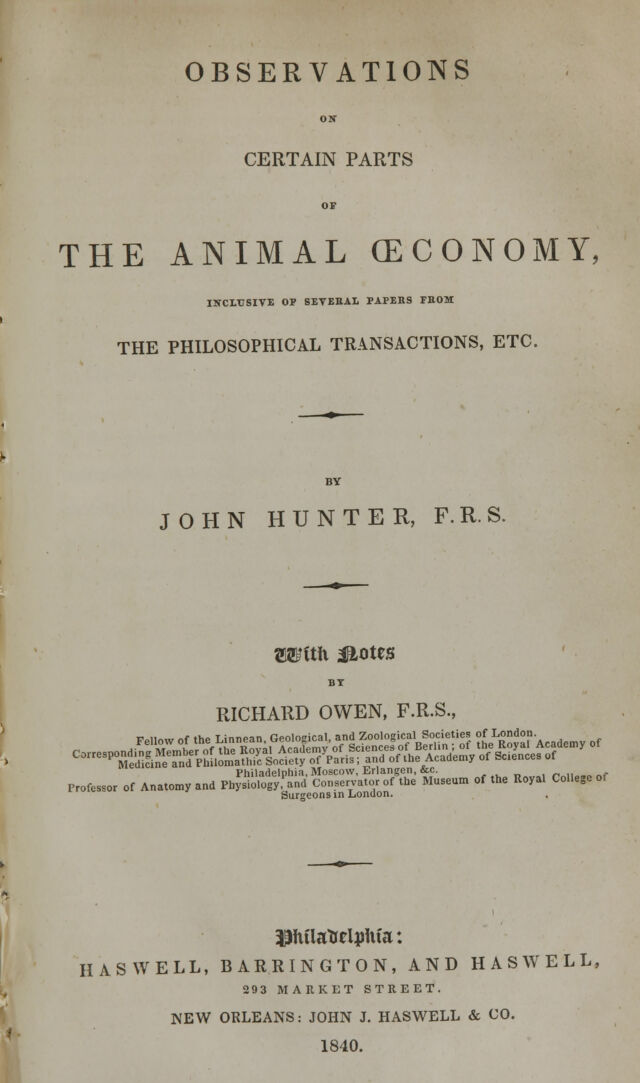
Observations on certain parts of the animal oeconomy : inclusive of several papers from the Philosophical transactions, etc. / by John Hunter ... ; with notes by Richard Owen.
- John Hunter
- Date:
- 1840
Licence: Public Domain Mark
Credit: Observations on certain parts of the animal oeconomy : inclusive of several papers from the Philosophical transactions, etc. / by John Hunter ... ; with notes by Richard Owen. Source: Wellcome Collection.
Provider: This material has been provided by the National Library of Medicine (U.S.), through the Medical Heritage Library. The original may be consulted at the National Library of Medicine (U.S.)
89/484
![is regular; and I am more inclined to be of this opinion from what takes place in the stomach of animals which are covered with hair, and which lick their own bodies, and of such as feed on whole animals which are likewise covered with hair. In the stomach of the calf, for instance, which licks its skin with its tongue, and swallows whatever is attached to the rough surface of that organ, balls of hair are often found; and on examining their surface the hairs in each hemisphere seem to arise from a centre, and to take the same direction, which is circular, corresponding to what would appear to be the axis of this motion, and resembling what we see in different parts of the skin of animals whose hair takes different turns. This regularity in the direction of the hair, in such balls, could not be produced if there was not a regular motion in the stomach. This motion is also proved in the dog; for I have seen a ball of this kind that had been thrown up from a dog's stomach, where the same regularity in the turns of the hair was very evident and complete. The same motion seems also to take place in the bird kind ; and of this the cuckoo is an example, which, in certain seasons living on caterpillars, some of which have hairs of a con- siderable length on their bodies, the ends of these are found sticking in the inner horny coat of the stomach or gizzard, while the hairs themselves are laid flat on its surface ; not in every direction, which would be the case if there was no regular motion, but all one way, arising from a central point placed in the middle of the horny part, and the appearance on the surface of both sides of the gizzard evidently corresponding.* These two facts prove, in my opinion, a regular circular motion taking place in the gizzard and mem- branous stomach, and therefore, most probably, something similar is carried on in stomachs of all the various kinds. Indeed this motion in the stomach is so considerable, that when there is no horny defence, we find the coats sometimes pierced by hard pointed substances. Thus, the cows which feed on the grass of bleeching- grounds have their stomachs, especially the second stuck full of pins; and fish which prey upon and swallow other fish entire, often have their stomachs pierced by the bones. Spallanzani calls the inner coat cartilaginous, whereas, in fact, it is a horny substance, forming an inner cuticle, but differing in some respects from the common cuticle; this horny substance not only differs in structure from the common cuticle, but in its attachment, from cuticle, nails, and hoofs. The cutis where it is covered by such substances, has a vast number of villi on its surface, which pass into corresponding perforations in the cuticle ; from this structure of parts, when the cuticle, nails, or hoofs are separated, their inner * [The appearance is so regular, that this hairy lining of the gizzard has been mistaken, for a natural peculiarity of the cuckoo. In one of these gizzards, which was exhibited at a meeting of the Zoological Society, I found the supposed gastric hairs under the microscope to present the complex structure characteristic of those of the larva of the tiger-moth (Arctia Caja). See Proceedings of the Zool. Soc. 1834, p. 9.]](https://iiif.wellcomecollection.org/image/b21131545_0089.jp2/full/800%2C/0/default.jpg)