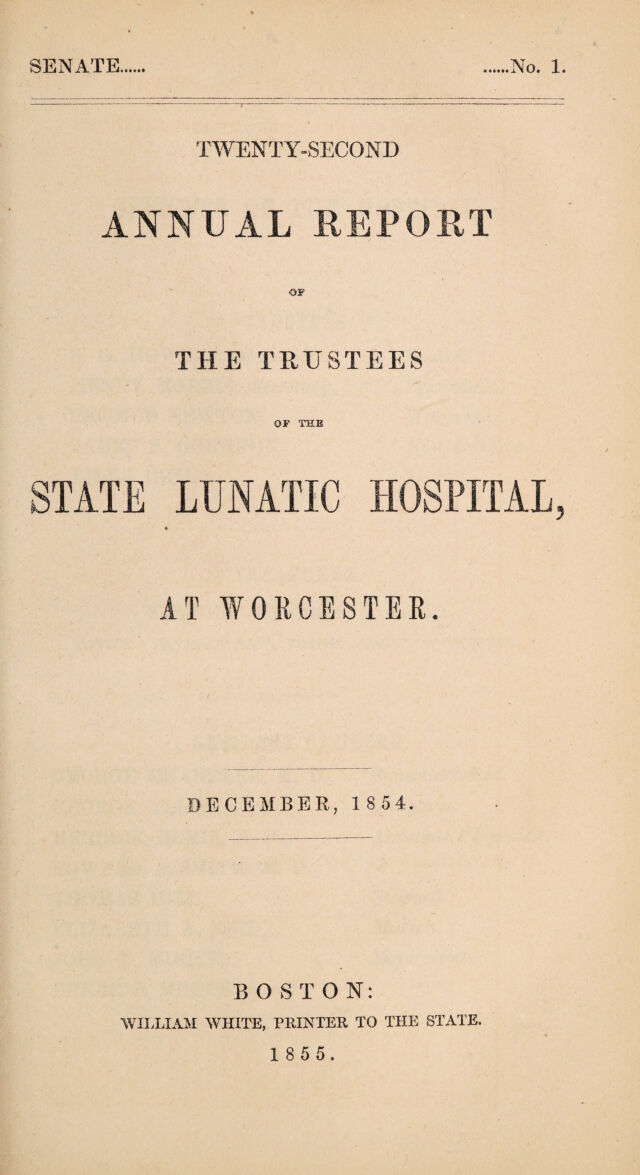
Twenty-second annual report of the trustees of the State Lunatic Hospital, at Worcester. December, 1854.
- State Lunatic Hospital at Worcester
- Date:
- 1855
Licence: Public Domain Mark
Credit: Twenty-second annual report of the trustees of the State Lunatic Hospital, at Worcester. December, 1854. Source: Wellcome Collection.
23/102 page 23
![I 1855.] SENATE—No. 1. 23 them as he walks through the wards. But every day effects changes, more or less considerable, hn every organized body and there are exceptional cases in which, by some extraordi¬ nary revolution in the system, reason is restored in the most unexpected manner. These changes may come at any time ; and they should be watched for, in order that the curative tendency may be favored. It should be assumed that they may happen to each and every patient, however old and % desperate his malady. As the anxious parent clings to hope so long as there is a spark of life in a child’s body, so the physician of a hospital for the insane should hold that there is a hope, because a possibility, of each patient’s restoration to reason. He should bear in mind that each one is some¬ body’s beloved child, or parent, or relation ; or, if not, then that he is doubly unfortunate, and should, therefore, be doubly interesting to him. Besides, there are many patients who will not speak of any pain or suffering which they may be undergoing ; and some who cunningly conceal it. Certainly, therefore, the physician should make frequent personal observation of each, and es¬ pecially of those cases where the patients are too much demented to seek relief of their own accord, even when suffer¬ ing ever so much. But if we allow that five minutes should be given to each case, the physician would have to labor ten hours daily in order to attend to each patient three times a week. It is true, he has his assistants ; but his ablest and most trusty assistants are his own senses, and upon them he must mainly rely. Such calculations of the division of time cannot, indeed, be very accurate or valuable; for some physicians have a natu¬ ral quickness of perception, so sharpened through practice, that a patient’s condition is seen at a glance, as by a flash of rev¬ elation. They have the intuition of genius. But surely, after making every allowance, it must be admitted that the proper medical care of the individual patients,—the regulation of their diet and regimen,—the contrivance of their amusements and occupations, and the general oversight of the moral condition of the great household—these things are enough to occupy fully and worthily the time and the energies of one man. But, besides these duties, many others are imposed upon the](https://iiif.wellcomecollection.org/image/b3031804x_0023.jp2/full/800%2C/0/default.jpg)