The Scientific American cyclopedia of formulas : partly based upon the twenty-eighth edition of Scientific American cyclopedia of receipts, notes and queries 15,000 formulas / edited by Albert A. Hopkins.
- Albert A. Hopkins
- Date:
- 1910
Licence: Public Domain Mark
Credit: The Scientific American cyclopedia of formulas : partly based upon the twenty-eighth edition of Scientific American cyclopedia of receipts, notes and queries 15,000 formulas / edited by Albert A. Hopkins. Source: Wellcome Collection.
115/1096 page 101
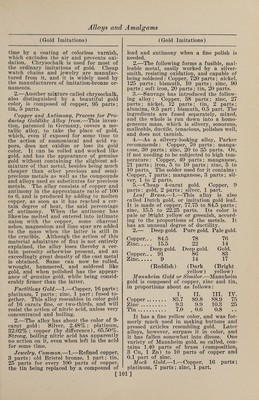
![(Gold Imitations) time by a coating of colorless varnish, which excludes the air and prevents oxi¬ dation. Chrysochalk is used for most of the ordinary imitations of gold. Cheap watch chains and jewelry are manufac¬ tured from it, and it is widely used by the manufacturers of imitation-bronze or¬ naments. 2.—Another mixture called chrysochalk, also distinguished by a beautiful gold color, is composed of copper, 95 parts; tin, 5 parts. Copper and Antimony, Process for Pro¬ ducing Goldlike Alloy from.—This inven¬ tion, patented in Germany, covers a me¬ tallic alloy, to take the place of gold, which, even if exposed for some time to the action of ammoniacal and acid va¬ pors, does not oxidize or lose its gold color. It can be rolled and worked like gold, and has the appearance of genuine gold without containing the slightest ad¬ mixture of that metal, besides being much cheaper than other precious and semi¬ precious metals as well as the compounds and alloys used as substitutes for precious metals. The alloy consists of copper and antimony in the approximate ratio of' 100 to 6, and is produced by adding to molten copper, as soon as it has reached a cer¬ tain degree of heat, the said percentage of antimony. When the antimony has likewise melted and entered into intimate union with the copper, some charcoal ashes, magnesium and lime spar are added to the mass when the latter is still in the crucible. Although the action of this material admixture of flux is not entirely explained, the alloy loses thereby a cer¬ tain porosity otherwise present, and an exceedingly great density of the cast metal is obtained. Same can now be rolled, wrought, hammered, and soldered like gold, and wfiien polished has the appear¬ ance of genuine gold, while being consid¬ erably firmer than the latter. Factitious Gold.—1.—Copper, 16 parts; platinum, 7 parts ; zinc, 1 part; fused to¬ gether. This alloy resembles in color gold of 16 carats fine, or two-thirds, and will resist the action of nitric acid, unless very concentrated and boiling. 2.—The alloy has about the color of 9- carat gold: Silver, 2.48%; platinum, 32.02%; copper (by difference), 65.50%. Strong, boiling nitric acid has apparently no action on it, even when left in the acid for some time. Jewelry, Common.—1.—Refined copper, 3 parts; old Bristol bronze, 1 part; tin, 25 parts for every 100 parts of copper, the tin being replaced by a compound of [ (Gold Imitations) lead and antimony when a fine polish is needed. 2. —The following forms a fusible, mal¬ leable metal, easily worked by a silver¬ smith, resisting oxidation, and capable of being soldered : Copper, 720 parts ; nickel, 125 parts; bismuth, 10 parts; zinc, 90 parts ; soft iron, 20 parts ; tin, 20 parts. 3. —Sauvage has introduced the follow¬ ing alloy: Copper, 58 parts; zinc, 27 parts; nickel, 12 parts; tin, 2 parts; alumina, 0.5 part; bismuth, 0.5 part. The ingredients are fused separately, mixed, and the whole is run down into a homo¬ geneous mass, which is silvery, sonorous, malleable, ductile, tenacious, polishes well, and does not tarnish. 4. —As a silvery-looking alloy, Parker recommends : Copper, 70 parts ; manga¬ nese, 30 parts ; zinc, 20 to 35 parts. Or, if not needing to be subjected to high tem¬ perature : Copper, 49 parts ; manganese, 21 parts ; iron, 5 to 10 parts ; zinc, 5 to 10 parts. The solder used for it contains : Copper, 7 parts; manganese, 3 parts ; sil¬ ver, 1 to 2 parts. 5. —Cheap 4-carat gold. Copper, 9 parts ; gold, 2 parts ; silver, 1 part. Leaf Brass.—1.—This alloy is also called Dutch gold, or imitation gold leaf. It is made of copper, 77.75 to 84.5 parts; zinc, 15.5 to 22.25 parts. Its color is pale or bright yellow or greenish, accord¬ ing to the proportions of the metals. It has an unusual degree of ductility. 2.— Copper.. Zinc.. .. Copper.. Zinc.... Deep gold. Pure gold. Pale gold . 84.5 78 76 . 15.5 22 14 Deep gold. Deep gold. Gold. . 91 86 83 . 9 14 17 (Reddish) (Dark yellow) (Bright yellow) Mannheim Gold or Similor.—Mannheim in proportions about as I. follows II. III. IV. Copper .... .. . 83.7 89.8 88.9 75 Zinc.. .. . 9.3 9.9 10.3 25 Tin. 7.0 . 0.6 0.8 • • It has a fine yellow color, and was for¬ merly much used in making buttons and pressed articles resembling gold. Later alloys, however, surpass it in color, and it has fallen somewhat into disuse. One variety of Mannheim gold, so called, con¬ tains 1.40 parts of brass (composition, 3 Cu2 1 Zn) to 10 parts of copper and 0.1 part of zinc. Mock Gold.—1.—Copper, 16 parts ; platinum, 7 parts ; zinc, 1 part. 101]](https://iiif.wellcomecollection.org/image/b31361523_0115.jp2/full/800%2C/0/default.jpg)