The Scientific American cyclopedia of formulas : partly based upon the twenty-eighth edition of Scientific American cyclopedia of receipts, notes and queries 15,000 formulas / edited by Albert A. Hopkins.
- Albert A. Hopkins
- Date:
- 1910
Licence: Public Domain Mark
Credit: The Scientific American cyclopedia of formulas : partly based upon the twenty-eighth edition of Scientific American cyclopedia of receipts, notes and queries 15,000 formulas / edited by Albert A. Hopkins. Source: Wellcome Collection.
127/1096 page 113
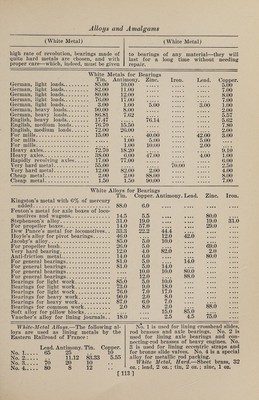
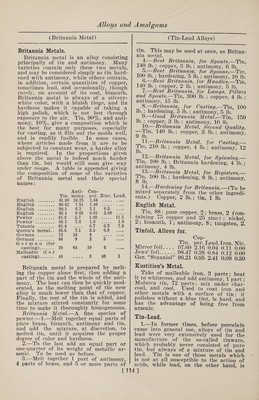
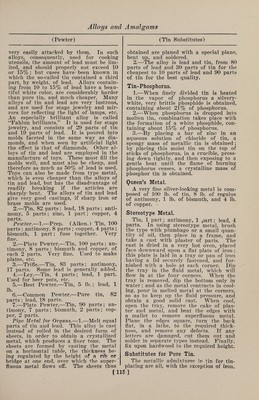
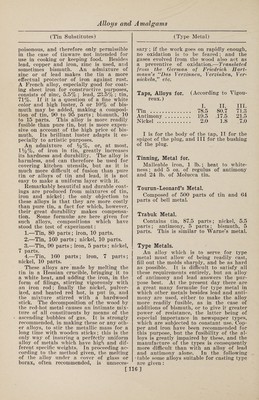
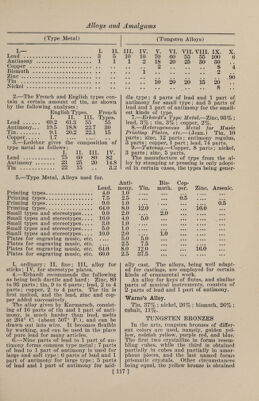
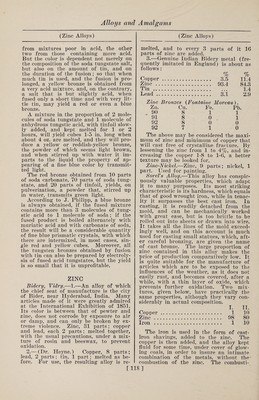
![(White Metal) (White Metal) high rate of revolution, bearings made of quite hard metals are chosen, and with proper care—which, indeed, must be given to bearings of any material—they will last for a long time without needing repair. White Metals for Bearings Tin. Antimony. Zinc. Iron. Lead. Copper. German, light loads. 85.00 10.00 5.00 German, light loads. 82.00 11.00 7.00 German, light loads. 80.00 12.00 8.00 German, light loads. 76.00 17.00 7.00 German, light loads. 3.00 1.00 5.00 3.00 1.00 German, heavy loads. 90.00 8.00 2.00 German, heavy loads. 86.81 7.62 5.57 English, heavy loads. 17.47 76.14 5.62 English, medium loads. 76.70 15.50 7.80 English, medium loads. 72.00 26.00 2.00 For mills. 15.00 40.00 42.00 3.00 For mills. 1.00 5.00 5.00 • • • • For mills. 1.00 10.00 2.00 • • • © Heavy axles. 72.70 18.20 9.10 Heavy axles. 38.00 6.00 47.00 4.00 1.00 Rapidly revolving axles.... 17.00 77.00 6.00 Very hard metal. 55.00 . 70.00 2.50 Very hard metal. 12.00 82.00 2.00 4.00 Cheap metal. 2.00 2.00 88.00 8.00 Cheap metal. 1.50 1.50 90.00 7.00 White Alloys for Bearings Tin. Copper. Antimony. Lead. Zinc. Iron. Kingston’s metal with 6% of mercury added. 88.0 6.0 .... • • • • • • • • • • • • Fenton’s metal for axle boxes of loco- motives and wagons. 14.5 5.5 • • • • 80.0 Stephenson’s alloy. 31.0 19.0 • • • • 19.0 3i.o For propeller boxes. 14.0 57.0 • • • • 29.0 Dew Pance’s metal for locomotives. . 33.3 22.2 44.4 • • • • • • • • Hoyle’s alloy for pivot bearings. 46.0 12.0 42.0 • • • • Jacoby’s alloy. 85.0 5.0 10.0 • • • • ■ • • • For propeller bush. 26.0 5.0 • • • • 69.0 Very hard bearing. 12.0 4.0 82.0 • • • • 2.0 Anti-friction metal. 14.0 6.0 • • • • 80.0 For general bearings. -.. 81.0 5.0 14.0 • • • • For general bearings. 81.0 5.0 14.0 • • • • • • • • For general bearings. • • • • 10.0 10.0 80.0 • « « • For general bearings. • • • • 12.0 88.0 • • • • Bearings for light work. . . . 85.0 5.0 10.0 • • • • • • • • Bearings for light work.... 73.0 9.0 18.0 • • • • • • • • Bearings for light work.... 76.0 7.0 17.0 • • • • • • • • Bearings for heavy work. . . 90.0 2.0 8.0 • • • • • • • • Bearings for heavy work... 87.0 6.0 7.0 • • • • • • • • Bearings for common work. 2.0 8.0 2.0 • • • • 88.0 Soft alloy for pillow blocks. • • • • 15.0 85.0 • • • • Vaucher’s alloy for lining journals. . 18.0 2.5 4.5 75.0 Wliite-Metal Alloys.—The following al¬ loys are used as lining metals by the Eastern Railroad of France : Lead. Antimony. Tin. Copper No. 1. 65 25 10 No. 2. # m 11.12 83.33 5.55 No. 3. 70 20 10 • • No. 4. 80 8 12 • • No. 1 is used for lining crosshead slides, rod brasses and axle bearings. No. 2 is used for lining axle bearings and con¬ necting-rod brasses of heavy engines. No. 3 is used for lining eccentric straps and for bronze slide valves. No. 4 is a special alloy for metallic rod packing. White Metal, Hard.—Sheet brass, 32 oz.; lead, 2 oz.; tin, 2 oz.; zinc, 1 oz. [113]](https://iiif.wellcomecollection.org/image/b31361523_0127.jp2/full/800%2C/0/default.jpg)