The Scientific American cyclopedia of formulas : partly based upon the twenty-eighth edition of Scientific American cyclopedia of receipts, notes and queries 15,000 formulas / edited by Albert A. Hopkins.
- Albert A. Hopkins
- Date:
- 1910
Licence: Public Domain Mark
Credit: The Scientific American cyclopedia of formulas : partly based upon the twenty-eighth edition of Scientific American cyclopedia of receipts, notes and queries 15,000 formulas / edited by Albert A. Hopkins. Source: Wellcome Collection.
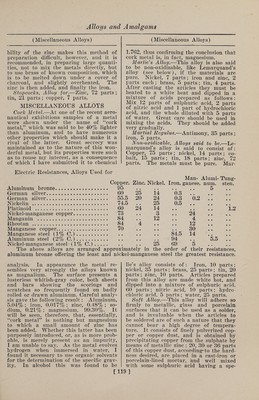
135/1096 page 121
![(Amalgams) surface. To make concave mirrors in this way the glass is surrounded by an edge of thick paper, pasted upon the concave side of the glass, and then treated as in making convex mirrors. If the work is properly done, the metal¬ lic surface will be perfectly bright, and will need no polishing; the trace of oil which adheres to it is removed by rubbing with ether or some other solvent. Sul¬ phide of carbon should not, however, be used, as this liquid frequently contains small quantities of sulphur in solution, which would turn the white color of the mirror black. Mirrors prepared with bismuth amalgam acquire a yellowish tone after long exposure to the air, a phe¬ nomenon which is to be attributed to the formation of small quantities of sulphur¬ ous metals upon the surface of the mir¬ ror. They are at present little used, as curved mirrors can be more easily and cheaply prepared by the separation of silver upon them. If the very thin layer of silver which has been produced upon the surface is coated with copper by elec¬ troplating, or simply treated with a so¬ lution of asphalt in benzol, the mirror will retain its luster for an indefinite time, as the metal is perfectly protected from the access of air. The bismuth amalgam for mirrors is made of bismuth, 2 parts; lead, 2 parts ; tin, 2 parts; mer¬ cury, 18 parts. Bismuth Amalgams. — The amalgam formed of 1 part of bismuth and 4 parts of quicksilver will cause the strong ad¬ herence of glass. For the purpose of economizing the bismuth, of which the price is high, the preceding amalgam is replaced by another composed of 2 parts of quicksilver, 1 part of bismuth, 1 part of lead and 1 part of tin. The bismuth, broken into small fragments, is added to the tin and lead, previously melted in the crucible, and when the mixture of the three metals becomes fluid the quick¬ silver is poured in, while stirring with an iron rod. The impurities floating on the surface are removed, and when the tem¬ perature is sufficiently lowered this amal¬ gam is slowly poured into the vessels to be tinned, which have been previously well cleaned and slightly heated. M. Ditte recommends for the same employment, as a very strong adherent to the glass, an amalgam obtained by dissolving, hot, 2 parts of bismuth and 1 part of lead in a solution of 1 part of tin in 10 parts of quicksilver. By causing a quantity of this amalgam to move around the in¬ side of a receiver, clean, dry, and slightly heated, the surface will be covered with (Amalgams) a thin, brilliant layer, which hardens quite rapidly. Bismuth Amalgam for Anatomical Preparations.—For the injection of ana¬ tomical pieces, an amalgam formed of 10 parts of quicksilver, 50 parts of bismuth, 31 parts of lead and 18 parts of tin, fus¬ ible at 77.5°, and solidifiable at 60° C., is made use of; or, again, an amalgam composed of 9 parts of Darcet alloy and 1 part of quicksilver, fusible at 53°, and pasty at a still lower temperature. This last amalgam may also be used for filling carious teeth. The Darcet alloy, as known, contains 2 parts of bismuth, 1 part of lead and 1 part of tin, and melts at 93°. The addition of 1 part of quick¬ silver lowers the fusing point to 40°. Fusible Alloy, for Silvering Glass.— Tin, 0 oz. ; lead, 10 oz. ; bismuth, 21 oz.; mercury, a small quantity. Production of Small Statues by Means of the Amalgam of Lipowitz Metal.— This amalgam is prepared as follows: Melt in a dish, cadmium, 3 parts, by weight; tin, 4 parts; bismuth, 15 parts; lead, 8 parts ; adding to the alloy, while still in fusion, 2 parts of quicksilver, pre¬ viously heated to about 100° C. The amal¬ gamation proceeds easily and smoothly. The liquid mass in the dish, which should be taken from the fire immediately upon the introduction of the mercury, is stirred until the contents solidify. While Lipo¬ witz alloy softens at 60° C., and fuses perfectly at 70° C., the amalgam has a still lower fusing point, which lies around 62° C. This amalgam is excellently adapted for the production of impressions of various objects of nature, direct im¬ pressions of leaves, and other delicate parts of plants having been made with its aid, which in point of sharpness are equal to the best plaster casts, and are possessed of a very pleasing appearance, the amalgam having a silver-white color and a lovely gloss. It is perfectly con¬ stant to influences of the air. This amal¬ gam has also been used with good suc¬ cess for the making of small statuettes and busts, which are hollow, and can be readily gilded or bronzed by electro-depo¬ sition. The production of small statues is successfully carried out by making a hollow gypsum mold of the articles to be cast, and heating the mold evenly to about 60° C.; a corresponding quantity of the molten amalgam is then poured in and the mold moved rapidly to and fro, so that the alloy is thrown against the sides all over. The shaking should be continued until it is certain that the amal¬ gam has solidified. When the mold has [121]](https://iiif.wellcomecollection.org/image/b31361523_0135.jp2/full/800%2C/0/default.jpg)