The Scientific American cyclopedia of formulas : partly based upon the twenty-eighth edition of Scientific American cyclopedia of receipts, notes and queries 15,000 formulas / edited by Albert A. Hopkins.
- Albert A. Hopkins
- Date:
- 1910
Licence: Public Domain Mark
Credit: The Scientific American cyclopedia of formulas : partly based upon the twenty-eighth edition of Scientific American cyclopedia of receipts, notes and queries 15,000 formulas / edited by Albert A. Hopkins. Source: Wellcome Collection.
136/1096 page 122
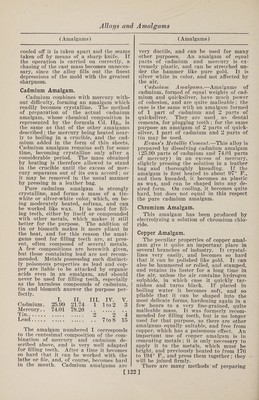
![(Amalgams) (Amalgams) cooled off it is taken apart and the seams taken off by means of a sharp knife. If the operation is carried on correctly, a chasing of the cast mass becomes unneces¬ sary, since the alloy fills out the finest depressions of the mold with the greatest sharpness. Cadmium Amalgam. Cadmium combines with mercury with¬ out difficulty, forming an amalgam which readily becomes crystalline. The method of preparation of the actual cadmium amalgam, whose chemical composition is represented by the formula Cd, IIg8, is the same as that of the other amalgams described; the mercury being heated near¬ ly to boiling in a crucible, and the cad¬ mium added in the form of thin sheets. Cadmium amalgam remains soft for some time, becoming crystalline only after a considerable period. The mass obtained by heating is therefore allowed to stand in the crucible until the excess of mer¬ cury separates out of its own accord ; or it may be removed in the usual manner by pressing in a leather bag. Pure cadmium amalgam is strongly crystalline, and forms a mass of a tin- white or silver-white color, which, on be¬ ing moderately heated, softens, and can be worked like wax. It is used for fill¬ ing teeth, either by itself or compounded with other metals, which makes it still better for the purpose. The addition of tin or bismuth makes it more pliant in the heat, and for this reason the amal¬ gams used for filling teeth are, at pres¬ ent, often composed of several metals. A few compositions are herewith given, but those containing lead are not recom¬ mended. Metals possessing such distinct¬ ly poisonous properties as lead and cop¬ per are liable to be attacked by organic acids even in an amalgam, and should never be used for filling teeth, especially as the harmless compounds of cadmium, tin and bismuth answer the purpose per¬ fectly. Cadmium. Mercury. . Tin. Lead. i. ii. hi. iv. y. 25.99 21.74 1 lto2 3 74.01 78.20 . ..... .... . 2 2 4 ..... ..... .. 7 to 8 15 The amalgam numbered I corresponds to the centesimal composition of the com¬ bination of mercury and cadmium de¬ scribed above, and is very well adapted for filling teeth. After a time it becomes so hard that it can be worked with the lathe or file, and, of course, becomes hard in the mouth. Cadmium amalgams are very ductile, and can be used for many other purposes. An amalgam of equal parts of cadmium and mercury is ex¬ tremely plastic, and can be stretched un¬ der the hammer like pure gold. It is silver white in color, and not affected by the air. Cadmium Amalgams.—Amalgams of cadmium, formed of equal weights of cad¬ mium and quicksilver, have much power of cohesion, and are quite malleable ; the case is the same with an amalgam formed of 1 part of cadmium and 2 parts of quicksilver. They are used, as dental cements, for plugging teeth ; for the same purpose an amalgam of 2 parts of quick¬ silver, 1 part of cadmium and 2 parts of tin may be used. Evans's Metallic Cement.—This alloy is prepared by dissolving cadmium amalgam (25.99 parts of cadmium and 74.01 parts of mercury) in an excess of mercury, slightly pressing the solution in a leather bag and thoroughly kneading. If the amalgam is first heated to about 97° F., and then kneaded, it becomes as plastic as wax, and can be shaped into any de¬ sired form. On cooling, it becomes quite hard, but does not equal in this respect the pure cadmium amalgam. Chromium Amalgam. This amalgam has been produced by electrolyzing a solution of chromium chlo¬ ride. Copper Amalgam. The peculiar properties of copper amal¬ gam give it quite an important place in several branches of industry. It crystal¬ lizes very easily, and becomes so hard that it can be polished like gold. It can also be hammered or rolled, and stamped, and retains its luster for a long time in the air, unless the air contains hydrogen sulphide, in which case it quickly tar¬ nishes and turns black. If placed in boiling water it becomes soft, and so pliable that it can be shaped into the most delicate forms, hardening again in a few hours to a very fine-grained, quite malleable mass. It was formerly recom¬ mended for filling teeth, but is no longer used for that purpose, as there are other amalgams equally suitable, and free from copper, which has a poisonous effect. An important use of copper amalgam is in cementing metals ; it is only necessary to apply it to the metals, which must be bright, and previously heated to from 176 to 194° F., and press them together; they will be joined firmly. There are many methods of preparing [122]](https://iiif.wellcomecollection.org/image/b31361523_0136.jp2/full/800%2C/0/default.jpg)