The Scientific American cyclopedia of formulas : partly based upon the twenty-eighth edition of Scientific American cyclopedia of receipts, notes and queries 15,000 formulas / edited by Albert A. Hopkins.
- Albert A. Hopkins
- Date:
- 1910
Licence: Public Domain Mark
Credit: The Scientific American cyclopedia of formulas : partly based upon the twenty-eighth edition of Scientific American cyclopedia of receipts, notes and queries 15,000 formulas / edited by Albert A. Hopkins. Source: Wellcome Collection.
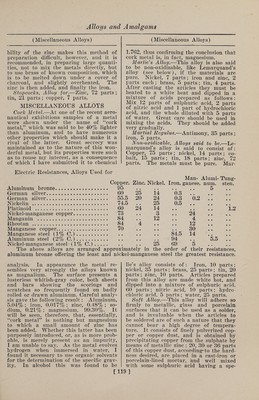
138/1096 page 124
![(Amalgams) the acid with boiling water, and allow the compound to cool. In 10 or 12 hours it becomes sufficiently hard to receive a brilliant polish, and to scratch the surface of tin or gold. When heated it becomes plastic, but does not contract on cooling. 8. —Gersnein’s Alloy.—Precipitated cop¬ per, 25 to 35 parts, ground with strong sulphuric acid, in a porcelain mortar, and then 65 to 70 parts, by weight, of mer¬ cury gradually added. When the copper is well amalgamated wash well in boiling water. When required for use, make it soft and plastic by heating to 375° G. and grinding in a mortar until soft. 9. —Ironier’s bronze consists of copper and tin, with 1% of mercury. Gold Amalgam. Gold belongs among those metals which combine easily with mercury, and a gold amalgam can be prepared by direct union of the two metals. If gold is used which has been obtained by the chemical process of reducing gold salts, it must be remem¬ bered that this, being in a finely divided state, will not dissolve easily in the mer¬ cury, for the reason that the fine powder will remain floating upon the surface. Gold, however, which has been reduced in the form of somewhat larger crystals, will dissolve in a comparatively short time. These small gold crystals can easily be obtained by dissolving gold chloride in amyl alcohol and heating the solution to the boiling point, whereby the gold will be separated in the form of small, lus¬ trous crystals. Gold amalgam is procured in large masses in the process of obtaining gold from auriferous sand, and by subsequent heating in iron retorts the combination is decomposed, the mercury volatilizes, and the pure gold is left behind. Gold forms with mercury a chemical combina¬ tion, Au4Hg, which has a strong tendency to crystallize. This must be prevented as much as possible in preparing the amalgam, since it is difficult to use a crystalline amalgam for gilding. A particularly good amalgam for fire gilding is prepared as follows: Place the gold in a graphite crucible, rubbed on the inside with chalk, to prevent ad¬ hesion, and bring the crucible to a red heat. It is not absolutely necessary to use chemically pure gold. Alloyed gold will answer the purpose, but it should be at least 22 carats fine, and preferably al¬ loyed with silver instead of copper. Gold amalgam containing copper will become as hard as stone in a short time, and (Amalgams) even a small percentage of copper makes it difficult to apply the amalgam uniform¬ ly to metallic surfaces. It is best to use the gold in the form of thin sheets, cut into small pieces before being put into the crucible. When it is red hot put into the crucible about the eighth or ninth part of the weight of the gold, previously heated to boiling. Stir constantly with an iron rod, and after a few minutes remove the crucible from the fire. If the amalgam were allowed to cool in the crucible it would become strongly crys¬ talline, and could not be used for fire gilding; as soon, therefore, as the crucible is taken from the fire, the contents are poured into a larger vessel filled with water, so that it may cool rapidly. The amalgam will crystallize in spite of all, if kept for any length of time ; it is there¬ fore advisable to have it freshly prepared a short time before use. In crystalliz¬ ing, the amalgam separates from the mer¬ cury in excess. If this has happened, it may be restored to its proper condition by heating in a crucible with an excess of mercury. In the preparation of the amalgam, as well as in the process of gilding, it is necessary to use a wind fur¬ nace with a well drawing chimney, as the vapors evolved from the mercury are in¬ jurious to health. Gold Amalgams. — 1. — Gilding with quicksilver.—This process of gilding, much employed formerly, is now but lit¬ tle used. It can be applied only to met¬ als slightly fusible, and capable of amal¬ gamation,. like silver, copper, bronze and brass. Iron can also be gilded by this method, provided it is previously covered with a coating of copper. To perform this gilding the surface is well cleaned, and the gold amalgam, consisting of 2 parts of gold and 1 part of quicksilver, prepared as mentioned before, is applied. The piece is afterward heated to about the red, so as to volatilize the mercury. The gold remains, superficially alloyed with the metal, and forms an extremely solid layer of deadened gold, which can be afterward polished. The volatiliza¬ tion should be effected under a chimney having a strong draught, in order to avoid the poisonous action of the mercurial va¬ pors. 2.—The amalgamation of gold finds its principal applications in the treatment of auriferous ores. The extraction of small spangles of gold scattered in gold-bearing sands is based on the ready dissolution of gold in quicksilver, and on the formation of an amalgam of solid gold by compres- [124 ]](https://iiif.wellcomecollection.org/image/b31361523_0138.jp2/full/800%2C/0/default.jpg)