The Scientific American cyclopedia of formulas : partly based upon the twenty-eighth edition of Scientific American cyclopedia of receipts, notes and queries 15,000 formulas / edited by Albert A. Hopkins.
- Albert A. Hopkins
- Date:
- 1910
Licence: Public Domain Mark
Credit: The Scientific American cyclopedia of formulas : partly based upon the twenty-eighth edition of Scientific American cyclopedia of receipts, notes and queries 15,000 formulas / edited by Albert A. Hopkins. Source: Wellcome Collection.
15/1096 page 1
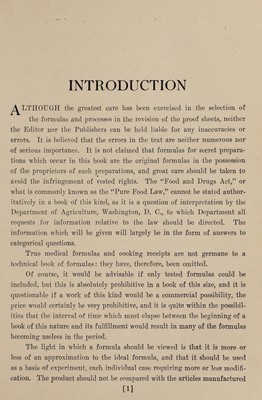
![• Vyri-.t INTRODUCTION ^^LTHOUGrH the greatest care has been exercised in the selection of the formulas and processes in the revision of the proof sheets, neither the Editor nor the Publishers can be held liable for any inaccuracies or errors. It is believed that the errors in the text are neither numerous nor of serious importance. It is not claimed that formulas for secret prepara¬ tions which occur in this book are the original formulas in the possession of the proprietors of such preparations, and great care should be taken to avoid the infringement of vested rights. The “Food and Drugs Act,” or what is commonly known as the “Pure Food Law,” cannot be stated author¬ itatively in a book of this kind, as it is a question of interpretation by the Department of Agriculture, Washington, D. C., to which Department all requests for information relative to the law should be directed. The information which will be given will largely be in the form of answers to categorical questions. True medical formulas and cooking receipts are not germane to a technical book of formulas: they have, therefore, been omitted. Of course, it would be advisable if only tested formulas could be included, but this is absolutely prohibitive in a book of this size, and it is questionable if a work of this kind would be a commercial possibility, the price would certainly be very prohibitive, and it is quite within the possibil¬ ities that the interval of time which must elapse between the beginning of a book of this nature and its fulfillment would result in many of the formulas becoming useless in the period. The light in which a formula should be viewed is that it is more or less of an approximation to the ideal formula, and that it should be used as a basis of experiment, each individual case requiring more or less modifi¬ cation. The product should not be compared with the articles manufactured [i]](https://iiif.wellcomecollection.org/image/b31361523_0015.jp2/full/800%2C/0/default.jpg)