The Scientific American cyclopedia of formulas : partly based upon the twenty-eighth edition of Scientific American cyclopedia of receipts, notes and queries 15,000 formulas / edited by Albert A. Hopkins.
- Albert A. Hopkins
- Date:
- 1910
Licence: Public Domain Mark
Credit: The Scientific American cyclopedia of formulas : partly based upon the twenty-eighth edition of Scientific American cyclopedia of receipts, notes and queries 15,000 formulas / edited by Albert A. Hopkins. Source: Wellcome Collection.
36/1096 page 22
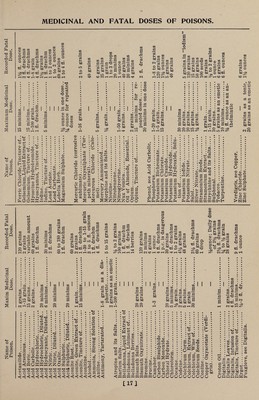
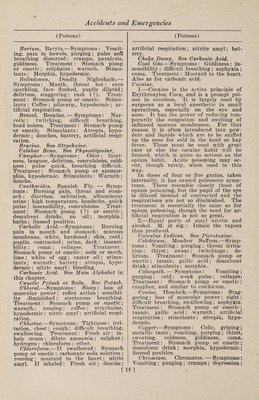
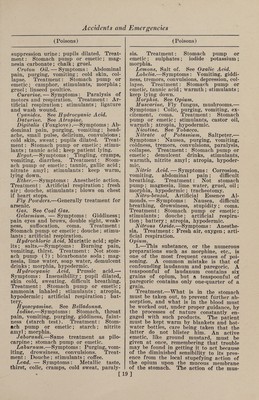
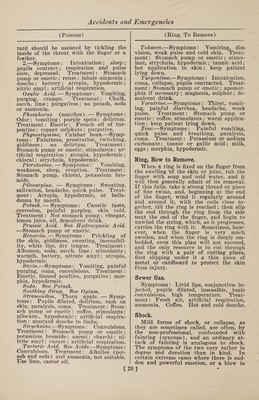
![(Suffocation) and are accompanied by great pain and swelling. Hot-water applications are the best to relieve the pain and reduce the swelling. The joint should be kept abso¬ lutely at rest. The best way to secure this is to strap the joint for some distance above and below with adhesive plaster, layer upon layer. Any weak spot which develops in the dressing can be easily re¬ inforced by an extra layer or two. Care should be taken that the strapping is not so tight as to interfere with the circula¬ tion of the blood. This can be determined by noting whether the part below the strapping remains warm. If it becomes cold and remains so, the strapping is probably too tight and should be promptly removed. After all, sprains are very un¬ satisfactory to treat. Not infrequently they take a longer time to heal than a fracture, and the joint is usually left weakened. Suffocation. There are several gases which, when in¬ haled, are followed by symptoms of as¬ phyxia. The condition is very similar to drowning, for these gases are not able to purify the blood by giving oxygen to it. Some of them, besides, are directly poi¬ sonous. (See cause of suffocation.) Sunstroke. Heat exhaustion differs from heatstroke in that the condition is one of very great depression, with a rapid, feeble pulse and heart action and a cold, moist skin and body temperature, instead of a hot skin with high fever. The treatment required is radically different from that employed in sunstroke. Take the person at once to a cool, shady, quiet place and give him plenty of fresh air and loosen the cloth¬ ing around the neck. Send for a doctor on the first appearance of the symptoms. Heat Exhaustion.—If the skin is cold and clammy, the case is one of heat ex¬ haustion and must be treated accordingly. Do not apply cold to the surface, but ap¬ ply heat by means of hot-water bottles or hot flannels and by rubbing the limbs. Give a tablespoonful of whisky or brandy in hot water or a teaspoonful of aromatic spirits of ammonia in water, or give strong tea or coffee. The object is to re¬ lieve the depression. Sunstroke or Heatstroke.—On the con¬ trary, for sunstroke or heatstroke, loosen the clothing around the neck and carry the patient to a cool place. If the skin is hot and the person seems feverish, cold applications are necessary. If there is a bathtub at hand, fill it [ (Throat, Bodies in) with cold water; put ice in the water if you can get it. Place the patient in the tub, all except the head, over which an ice cap should be placed. To make this, mash a piece of ice in a towel. Keep the patient in the tub for fifteen minutes and then put him in bed, between blankets, without drying him. If in fifteen min¬ utes he shows no signs, or very feeble ones, of returning consciousness, replace him in the bath and treat him as before. t If there is no bathtub at hand, take off his clothes, wrap him in a sheet and keep this wet with cold water. If this can¬ not be done sponge head, neck, chest or other parts of the body with cold water, and if ice can be had, use this freely by rubbing over the chest and applying to the head and armpits. Repeat the baths at intervals of fifteen minutes until the patient stays conscious and the body re¬ mains cool. If natural breathing does not return, perform artificial respiration, Sylvester’s method. If ice cannot be obtained, wet towels with cold water and wrap the head in them, changing them frequently. The treatment is, in brief, to use any means to reduce the temperature of the body by applying cold externally. Continue such treatment until the tem¬ perature of the skin is reduced. If the patient improves, but the symptoms of fever recur, renew the cold applications as before. If the patient is able to swal¬ low, frequent drinks of cold water may be given him, but do not give any whisky or other alcoholic stimulants. Take care that the patient does not become stupid and his body hot again. If this hap¬ pens, repeat the same methods. Medi¬ cines do not seem to be of much avail. Throat, Foreign Bodies in. In case an article of food, or other substance, gets into the back of the mouth and cannot be swallowed, it should be dragged out with the aid of a hairpin straightened and bent at the extremity. If the body is firm in character, a pair of scissors, separated at the rivet and one blade held by the patient, will furnish a loop with which it may be extracted. Toothache. This is sometimes neuralgic and some¬ times due to decay. Heat applied to the face outside, and a heated half of a fig held inside, often relieve the former kind, and sometimes afford temporary relief in the latter kind. If- the cavity can be cleansed out with a broom-splint and ]](https://iiif.wellcomecollection.org/image/b31361523_0036.jp2/full/800%2C/0/default.jpg)