The Scientific American cyclopedia of formulas : partly based upon the twenty-eighth edition of Scientific American cyclopedia of receipts, notes and queries 15,000 formulas / edited by Albert A. Hopkins.
- Albert A. Hopkins
- Date:
- 1910
Licence: Public Domain Mark
Credit: The Scientific American cyclopedia of formulas : partly based upon the twenty-eighth edition of Scientific American cyclopedia of receipts, notes and queries 15,000 formulas / edited by Albert A. Hopkins. Source: Wellcome Collection.
39/1096 page 25
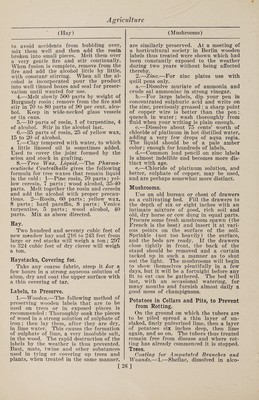
![CHAPTER II AGRICULTURE BRIEP SCHEME OF CLASSIFICATION MISCELLANEOUS FORMULAS MILK BUTTER POULTRY CHEESE VETERINARY FORMULAS FERTILIZERS WEEDS The subject of Insecticides is so important that it has been made a separate chapter in connection with pests of all kinds. Attention is called to the fact that the Department of Agriculture issues important agricultural literature for a low price and many of the publications are free. Address the Department of Agricult¬ ure, Washington, D. C. Any reasonable questions will be answered free of charge. MISCELLANEOUS FORMULAS. Apples. The utilization of the poorer grades of fruit is frequently an important matter to the grower. That portion of a crop which is of too low grade to market in the ordinary way can often be made to pay a large part, at least, of the expense of maintaining the orchard or fruit plan¬ tation if it is converted into some other form or handled in some way other than that practiced with the better grades. In some of the apple-growing districts the evaporating industry has kept pace with the planting of orchards and has become an important factor in the utilization of the fruit which is unfit or would prove unprofitable for marketing in the fresh state. Farmers’ Bulletin 291, issued by the United States Department of Agriculture, entitled “Evaporation of Apples,’’ by H. P. Gould, gives very valuable information on this subject. Birdlime. Boil the middle bark of the holly, gath¬ ered in June or July, for 6 or 8 hours in water, until it becomes tender; then drain off the water and place it in a pit under ground, in layers with fern, and surround it with stones. Leave it to ferment for two or three weeks, until it forms a sort of mucilage, which must be pounded in a mortar into a mass and well rubbed be¬ tween the hands in running water until all the refuse is worked out; then place it in an earthen vessel and leave it for four or five days to ferment and purify itself. Remarks: Birdlime may also be made from mistletoe berries, the bark of the wayfaring tree and other vegetables by a similar process. Should any of it stick to the hands, it may be removed by means of a little oil of lemon bottoms or turpentine. Use. To rub over twigs to catch birds or small animals. It is said to be discutient when applied externally. Branding Stock, Ink for. Shellac, 2 oz.; borax, 2 oz.; gum ara- bic, 25 oz.; water, 25 oz.; lampblack, sufficient. Boil the borax and shellac in the water until dissolved. Remove the mixture from the fire and, when cool, add the gum arabic and sufficient water to make 25 ounces. Then add enough lamp¬ black to bring the whole to a proper con¬ sistency. For red ink use Venetian red instead of lampblack, for blue use ultra- marine. Grafting Wax. 1. —T. Tidmarsh recommends in The Gardeners’ Chronicle the following mix¬ ture : Beeswax, 1 part; rosin, 3 parts. Melt together. For use, remelt in a glue pot, the water jacket of which will retain it in a workable consistency for a consid¬ erable time and also prevent it from being overheated to a point dangerous to the scions. For hot climates the proportion of rosin should be increased to 4 to 1 of wax. 2. —Yellow wax, 6 parts; rosin, 10 parts; turpentine, 30 parts; lard oil, 1 part. 3. —Black pitch, 10 parts; white pitch, 10 < parts; Burgundy pitch, 10 parts; rosin, 10 parts; fatty varnish, 4 parts; red lead, 4 parts; alcohol, 8 parts. Put the varnish and the red oxide of lead in a glazed earthenware vessel of sufficient size Always consult the Index when using this book. [25]](https://iiif.wellcomecollection.org/image/b31361523_0039.jp2/full/800%2C/0/default.jpg)